The case for giving Cindy Rose (below) a pay raise — rejected by a quarter of WPP shareholders — matters because of the divisions we now see within and between ad agency holding groups.

What happened to the once mighty ad agencies of Madison Avenue and Soho, whose great creative and strategic minds used to make or break businesses?
Are agencies becoming increasingly minor characters because advertising is no longer a game of big ideas and spectacle, but a small, shabby game of following people around the internet with surveillance tactics and popups? Or do they deserve more blame for failing to make the case that the power of creativity has never been more necessary in a world of rising misinformation and automated mediocrity?
Whatever your view of agencies in 2026, there is likely a common reflex when reading stories from the past week about WPP and Publicis Groupe CEOs receiving substantial increases in their pay. My eyebrows twitched, but each to their own.
But in the case of WPP, not all shareholders did agree. In fact, one in four said no to WPP CEO Cindy Rose’s proposed pay increase, from a maximum package of £8.6m to £11.1m per year. Everything else sailed through the company’s AGM last Friday, including Rose herself being “re-elected” at 99.63%, which is a number that even Vladimir Putin might blanche at.
But seriously folks, this story matters a lot more than ‘rich company boss gets richer’. Let me explain.
WPP’s CEO pay: what’s really a fair comparison?
To understand why one in four matters, you need to know about the 80% rule. Under the UK Corporate Governance Code, if a pay resolution at a public company AGM fails to reach 80% approval, the board is legally required to engage with dissenting shareholders and report back within six months. Both WPP pay resolutions fell below that threshold (Resolution 3, the compensation committee report, at 75.84%; Resolution 4, the forward pay policy, at 74.92%).
So let’s see what WPP report back with in six months. But why go through this headache in the first place for company whose share price is so historically low that last year it fell out of the FTSE 100?
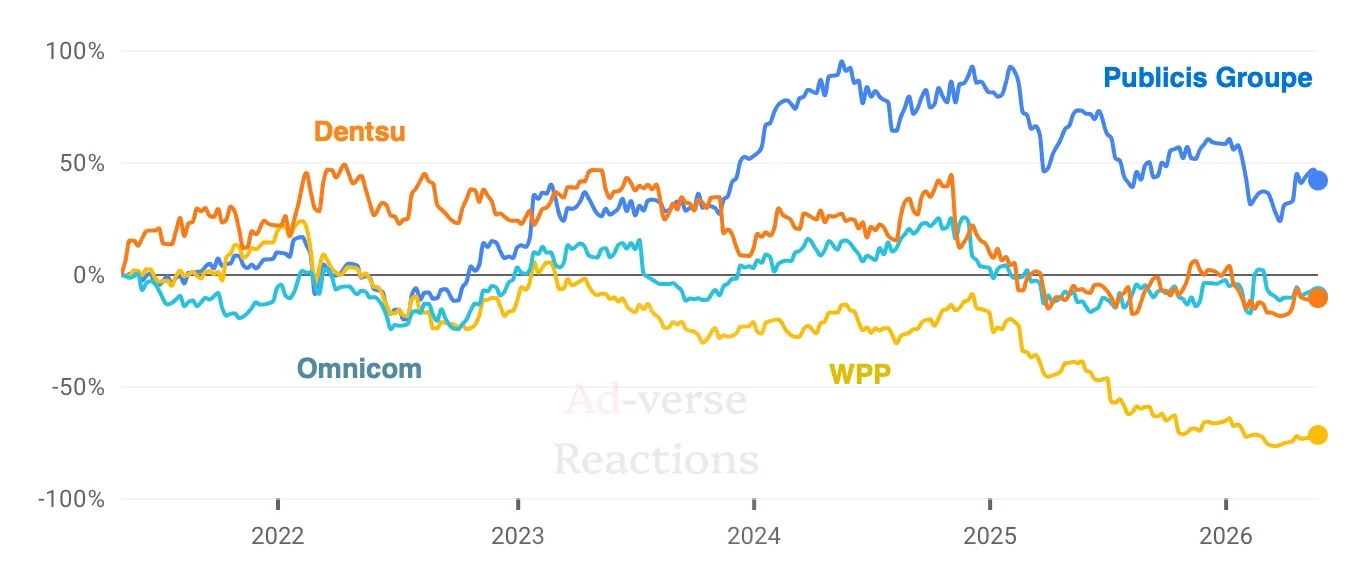
The first reason is peer comparison. In its latest annual report, WPP felt it necessary to publish the historic pay packages of its rivals to show how frugal it had been. John Wren at Omnicom earned $21.7m (£15.9m) in 2024 and Sadoun was, even before his own pay rise was revealed last week, earning a “theoretical” maximum of £10m. You don’t close the gap, the thinking goes, by having a CEO who only makes a piffling £8.6m!
The second reason is even more awkward: WPP’s boss was apparently being paid so pitifully that she was outearned by about a third of WPP’s executive committee! The traditional pyramid of pay, where the CEO is top dog and tranches below get paid progressively less, had broken down.
The third reason is perhaps the most difficult to swallow: CEOs like Cindy Rose are not just paid for past performance, their pay is intended to send a signal and an incentive for future improved performance. The ‘shareholder big bet’ was shown in its most extreme form last year by Tesla, which gave Elon Musk a near-$1tn pay package. Musk’s pay was structured entirely around milestones not yet hit, designed to keep the most important person in the building focused and retained.
The WPP board is making a smaller version of the same argument: Rose can earn £11.1m if she hits her targets, we believe she will, and here is the structure to make that happen.
You can’t imagine there being a similar rebellion over at Publicis Groupe, if it had the same shareholder voting rules. Chairman and CEO Arthur received a 20% salary increase, taking his potential package to €10.5m. But it’s a non-story because Publicis has posted 20 consecutive quarters of growth and, before Omnicom fattened itself by gobbling up IPG, had outmuscled WPP to become the world’s biggest advertising services group. In 2025, Publicis Media won more than $10bn in new business, according to Comvergence data, while WPP Media lost more than $2bn net. Yes, it has since won $1.9bn in Q1 of this year, but these are not comparable businesses at this moment in time.
In other words, Sadoun is being retained for performance already delivered, but Rose is being incentivised for performance not yet achieved.
Money is fiction. Value is reality
In recent years, Publicis built its data, technology and e-commerce capabilities over years of deliberate acquisition. Meanwhile, WPP, under Read, was painstakingly trying to simplify its hodgepodge of agencies, bespoke client teams, and integrated verticals, following years of aggressive acquisitions under Sir Martin Sorrell.
As for how WPP turns around under Rose now, last week’s profile interview by the excellent Suzanne Vranjica of the Wall Street Journal had some revealing lines. Such as:
“Rose said that once WPP returns to organic revenue growth, which she expects in 2027, it will allocate more funds to dealmaking and bolster such areas as commerce and social-influencer marketing.”
2027? Another seven months (at best!) feels like a long time to wait to start catching up. Especially since most new money in this industry is flowing directly to Meta, Google and Amazon via small and medium sized businesses who buy direct without agencies (including on verticals such as ecommerce and social media/influencer!)
As for internal “pay compression”, the timing of this argument isn’t great. WPP’s revenue fell 6.7% like-for-like in Q1. As Mark Ritson’s uncharacteristically dry, sober and unsweary Adweek article pointed out, WPP’s headline operating margin compressed 200 basis points in a single year, from 15% to 13%. And the company’s share price is down by about 30% since Rose took over in September.
While she received zero financial performance bonus (because she didn’t earn it), she did, however, receive her maximum bonus for non-financial metrics. The board gave her full marks for the softer stuff in a year the numbers went the wrong way. That is, as far as I can tell, the thing that 25% of shareholders were voting against.
The forward signal argument is the most interesting to unpick, because it isn’t wrong in principle. But a bet like this requires a credible forward path.
The risk of putting more ‘skin in the game’
If, as Rose hopes, WPP returns to organic growth next year, the market will be even more consolidated, more expensive to enter, and more densely populated by competitors who moved earlier. That makes it more likely that the board is pricing in a recovery that is, optimistically , a 2028 or 2029 story.
Will shareholders continue to have the same level of patience for that long?
There is one aspect to this supposed turnaround story that doesn’t give me confidence. For all the talk of transformation and innovation, this is still a business which, you know, needs to bring in more money than it spends. Business experts call this “profit”.
The danger is that WPP becomes so desperate to portray a winning turnaround story (to prop up the share price) that it continues to play the same, self-defeating game which has plagued all large agency groups for decades now: race-to-the bottom pricing.
Because WPP is winning accounts: the UK government media account, Reckitt, Estée Lauder, Jaguar… but if revenue keeps falling, it’s the signature of a company defending market share by cutting prices. Then every account that is won on those worse terms resets the floor for the next pitch.
This was bizarrely framed in the same WSJ interview: during a recent pitch for a healthcare company, Rose cut the agency’s fee, tying compensation to performance targets. Greg Paull of R3 (now part of MediaSense) was quoted describing this as WPP “putting skin in the game,” adding that this had not been a hallmark of the holding group. He meant it as a compliment.
Strange. Firstly, because fee-cutting to win business is not a new strategy at WPP, from everything that I’ve heard in over a decade of my covering this industry, no matter the CEO.
Secondly, the decline of fees relative to scope of work by big agencies has been a defining characteristic of this industry for decades. You can read Michael Farmer’s books and Substack to understand, with ample evidence and explanation, how the holding company model was always propped up by a cross-subsidy: undercharge on creative, recover the margin on media buying and production markup.
But now the same pressure is hitting media, as platforms commoditise buying and clients demand transparency on every pound spent. So the cross-subsidy is collapsing from both ends. Where left is there to claw the margin back from?
To quote Ritson: “The only question that matters is whether clients will pay more.”
That is the problem the WPP turnaround has to solve, and Rose’s brainchild scheme Elevate28, to make £676m in cost savings, is a margin defence operation that buys time. Meanwhile, ever weaker pricing erodes the top line.
Again, how much patience are these shareholders really expected to have?
See you in six months
If only politics were the same: a winning politician is forced to consult with the people who voted against them. Because they represent all the people, not just their supporters, right?
So it’s a very good thing that UK corporate law requires WPP to engage with dissenting shareholders when votes fall below 80% approval and report back in six months. Corporate behaviour might be even better if the actual workers were entitled to representation on boards, as they are in Germany, but that’s for a different column.
For now, this story matters because it really will signal whether there is much hope for the holding company model to survive. Is this a board that updates its view of WPP’s position in light of new meaningful evidence or another round of investor relations management that concludes with minor adjustments and a press release about constructive dialogue?
I suspect the data will answer that question before the board does.
 This article first appeared in Ad-verse Reactions, a newsletter written by independent journalist and consultant Omar Oakes, covering the economics, power structures and unintended consequences shaping advertising and media. You can subscribe to Ad-verse Reactions for regular analysis at omaroakes.substack.com.