
America’s FTC has given ad holding companies a permanent court order banning coordinated brand-safety standards. The silence that followed tells you everything.
The best questions are simple to ask but difficult to answer.
On 15 April, the US Federal Trade Commission filed “consent decrees” — permanent court orders banning coordinated brand-safety standards — against all five major holding companies: WPP, Publicis Groupe, Dentsu, Omnicom, and IPG.
That sounds like it should be a major story. Not least because of the sheer scale of its implications.
And yet, nearly a week later, I haven’t been able to find a single statement on this by a major industry body, nor read an executive’s on-record response.
Everyone else had somewhere to be.
Even in a week where Publicis CEO Arthur Sadoun told Adweek he wasn’t here to squeeze people, squeeze shares, or please Wall Street — a line lapped up by all the trades. Hard not to laugh at a line like that when the world’s biggest media market has just squeezed you and your competitors for not throwing enough money at Breitbart and X.
What’s next? Pornhub and OnlyFans crying foul because advertisers are “colluding” to demonetise content featuring naked people?
This story matters because the industry just lost the right to pretend it has standards.
And no one is prepared to say a word about it.
What brand safety actually was (and wasn’t)
GARM — the Global Alliance for Responsible Media — was founded in 2019 under the World Federation of Advertisers, after advertisers were outraged to find their brands appearing next to footage of the Christchurch mosque massacre, livestreamed on Facebook and still watchable on YouTube several hours later. It brought together advertisers, agencies, and platforms around a shared framework: common definitions of harmful content, and a commitment not to fund them.
But GARM still matters because of what it represented: a shared floor. A thing everyone agreed, publicly, not to stand beneath. That’s not nothing. And yet the frameworks that came before and after — NewsGuard integrations, DoubleVerify, IAS (and, my personal favourite, the IAB Gold Standard) — were like a fresh coat of paint on a burning building.
GARM also matters because it was a central plank of the FTC’s case against the agency holdcos.
Under the Sherman Act — the same law used to break up cartels — it argued that the holdcos had acted as a single entity by coordinating their brand safety standards through GARM and the 4As’ Advertiser Protection Bureau. Competitors can’t agree to use identical standards any more than they can agree to charge identical prices. The consent decrees permanently ban any future coordination.
Each holdco must now develop its own standards independently — or not at all. What could go wrong?
A culture war against mainstream media
The antitrust framing is the tell; you can’t outlaw brand safety on free speech grounds. But you can outlaw competitors colluding on it. So that’s what they charged.
Don’t think so? Read the FTC complaint’s own language. The agencies “disfavoured political viewpoints” and were “discriminating against speech and ideas.” The named targets: NewsGuard, the Global Disinformation Index. The implicit beneficiaries: Breitbart, Newsmax, X.
X, of course, has never recovered from the advertiser exodus that followed Elon Musk’s $22bn acquisition of Twitter in 2022. Not content with turning X into a cesspit by binning content moderators and heavily slanting the algorithm towards favoured politicians, Musk saw fit to tell advertisers to “go fuck themselves” if they didn’t like his enterprising approach. The company is now less a social media company and more a tech bolt-on for Musk’s AI and aerospace interests, hence its inflated valuation since plummeting to just $9.4bn in September 2024.
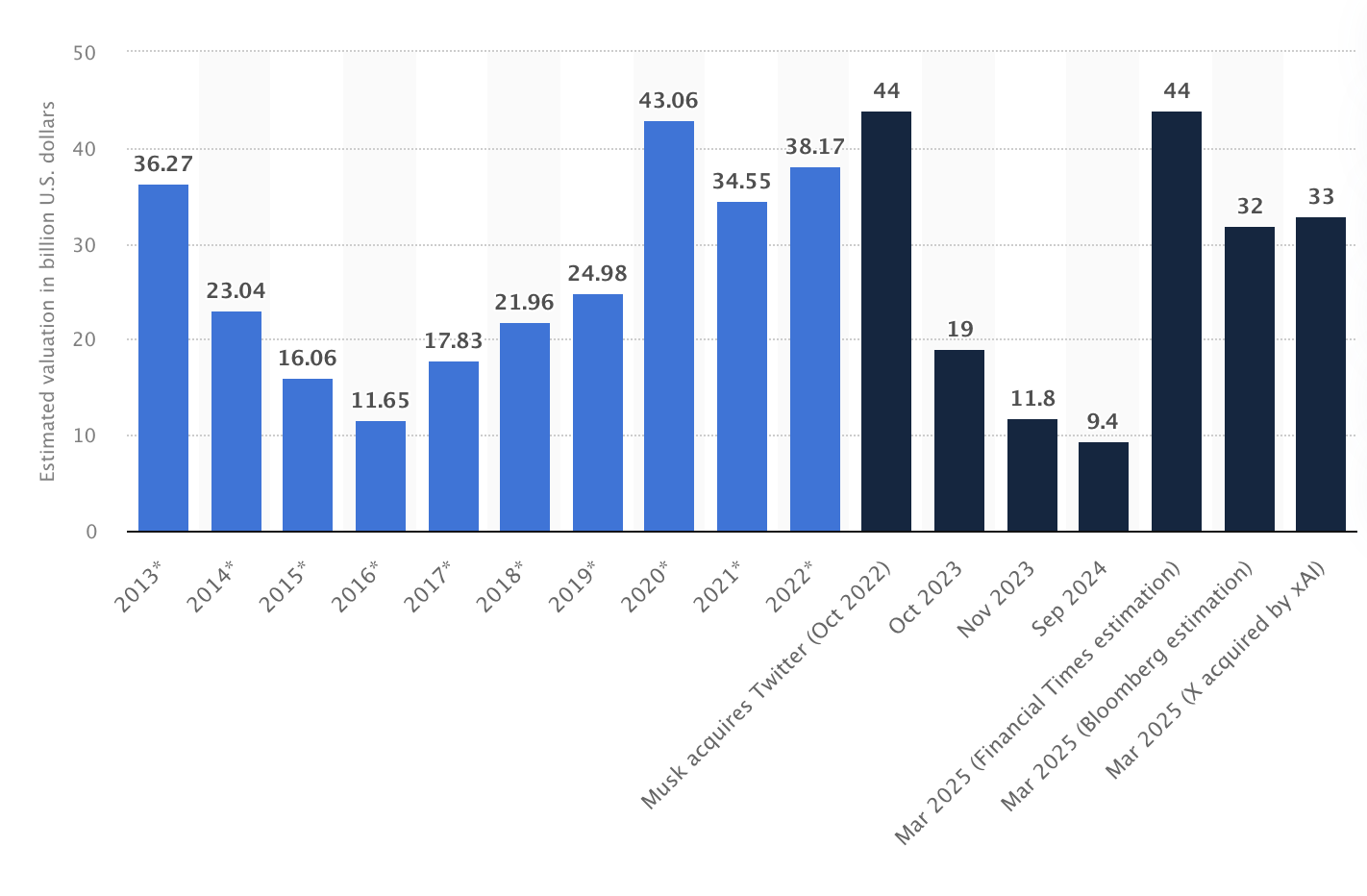
That’s a mini case study in why X is not attractive to advertisers; it’s not ‘brand safe’ by design. Nor is any ‘platform’ in which unverified users can post whatever they like with editorial or legal hurdles to jump through.
And yet Ferguson said in the FTC’s own press release that the agencies’ ‘agreement’ had “distorted the marketplace of ideas by discriminating against speech and ideas that fell below the unlawfully agreed-upon floor.”
That’s not the language of antitrust enforcement. That’s the language of a culture war. A culture war against the very idea of mainstream media itself.
This is the same administration whose FCC conditioned its approval of the Paramount merger on a Trump-appointed ombudsman for CBS News and the cancellation of Stephen Colbert, and whose FTC has leaned on media owners to silence on-air talent for insufficient political deference.
The brand-safety case fits the same pattern: regulatory power deployed as political instrument.
In July 2024, I asked in The Media Leader what faith advertisers could have that X’s algorithm wouldn’t be bent toward the politician its owner had just donated hundreds of millions to support. The answer, it turns out, was: none — and when advertisers acted on that, the administration reached for the regulatory apparatus to make sure they kept spending there anyway.
The FTC consent decrees are regulatory capture with an antitrust filing stapled to them. Every holding company CEO knows this. NewsGuard’s own co-CEO said publicly that “Andrew Ferguson is simply responding to the lobbying of Newsmax.”
Every holding company CEO knows this too. Have they said anything in response?
No. I suppose they just had somewhere to be.
Why the silence is the story
But don’t confuse silence for cowardice. It’s more calculated than that, and more corrosive.
The holding companies are, simultaneously:
- dependent on Meta and Google for the bulk of their media buying
- pitching AI partnerships to the same US tech ecosystem whose political allies brought this case
- running global businesses that cannot afford to be seen taking sides in American culture-war politics
- and operating under an administration that has demonstrated it will use every lever — antitrust, federal contracting, approval processes — as a political instrument.
You know what that adds up to? An industry that has decided its commitment to unbiased advice is worth exactly as much as it costs to maintain.
When the cost goes up, the commitment goes down.
GARM collapsed for the same reason it was always going to collapse: voluntary consensus works until someone powerful objects. So there was no actual floor — there was just an agreement to pretend there was a floor.
The moment the pretence became costly, the floor disappeared.
The trade press, to its credit, filed the story. Adweek ran it. Campaign Asia ran it. eMarketer ran it. All in the same register: neutral; procedural; done. Like a planning application.
This isn’t a coincidence. The holding companies are trade media’s primary sources, their biggest advertisers, and the ones who fill the tables at their awards dinners. That’s not a conspiracy — it’s an incentive structure. The same incentive structure that bought the holdcos’ silence bought the trade press’s neutrality. Nobody needed to make a call. Everyone already knew the shape of the story they weren’t going to write.
Everyone, it seems, had somewhere else to be.
 This article first appeared in Ad-verse Reactions, a newsletter written by independent journalist and consultant Omar Oakes, covering the economics, power structures and unintended consequences shaping advertising and media. You can subscribe to Ad-verse Reactions for regular analysis at omaroakes.substack.com.