
Facebook, Instagram and YouTube have made themselves too embedded to fear real regulation. It’s time to think much bigger about our digital future
There is a non-zero chance that Mark Zuckerberg doesn’t even know that the UK proposed to ban Facebook and Instagram for under-16s on Monday.
There is almost 100% certainty that he doesn’t care.
Why should he? Meta’s stock finished 5% up at the Nasdaq’s close on Monday evening, pushing its market cap past $1.5 trillion. Yesterday’s 5% move alone added roughly $75 billion to Meta’s value: about 50 times the maximum fine Ofcom could theoretically impose under the Online Safety Act. (Trillion, incidentally, is a word that used to be so rarely deployed that I never needed to shorten it, but we now we live in a world of actual trillionaires and trillion-dollar companies.)
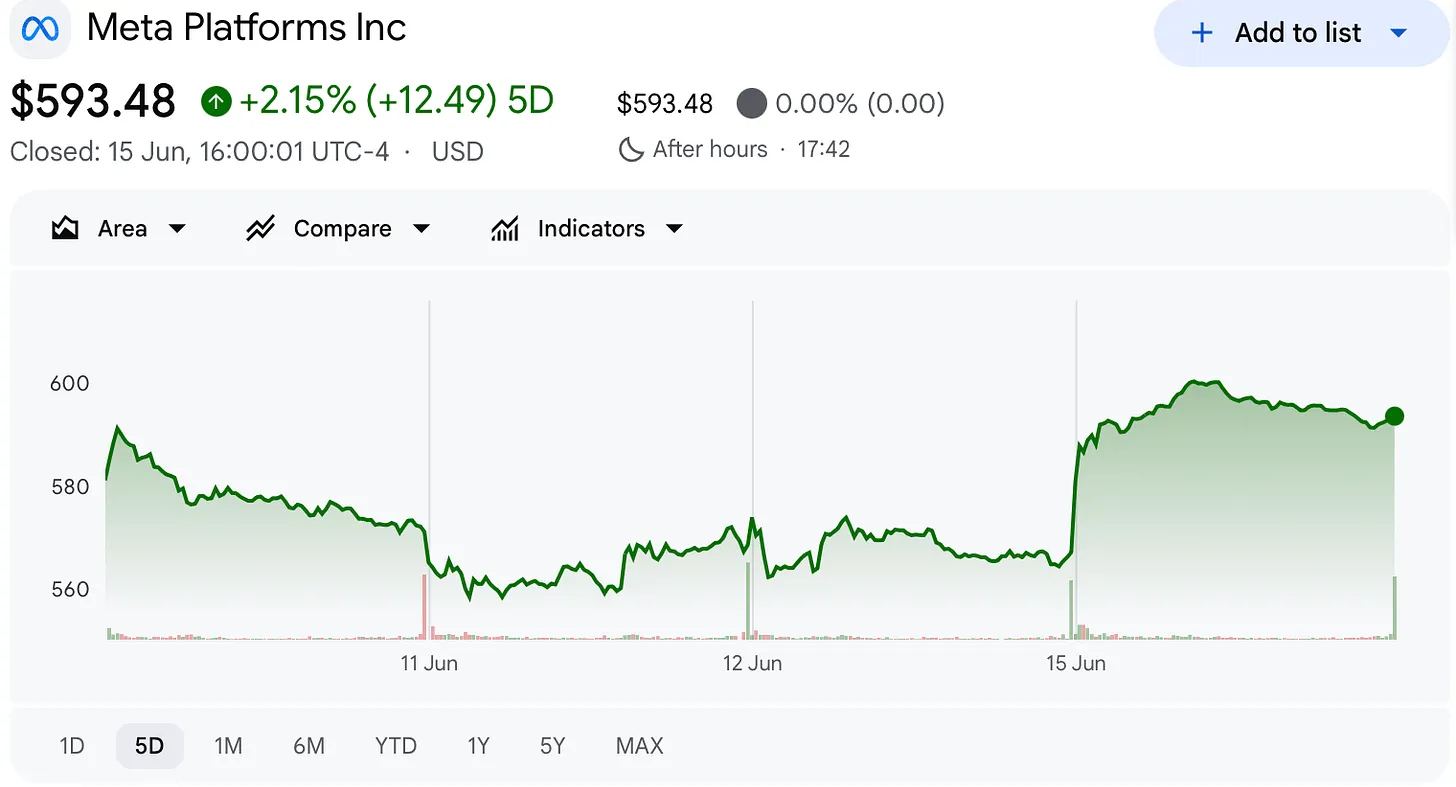
Meta has become the rarest of corporate creatures: it trades as best of both worlds. The safety of a utility – like holding British Gas shares in the 1990s – combined with the growth profile of a startup. Its latest quarterly earnings showed year-on-year revenue growth of 33%. That is, to use a technical term, insane, for a company already that size to grow that quickly.
So Meta waves its hands, launches a new AI feature as it did yesterday, and completely overshadows any fleeting existential concerns you might have about a company now facing some kind of ban in multiple Western countries. The market isn’t worried. Neither is Zuckerberg.
And so yesterday’s social media ban is largely theatre.
The ban won’t work. And even if it did, the deeper problem can’t be fixed this way.
Why it won’t work
I attended a panel on this very subject last week, hosted under the banner Who Cares About Safety?.
This was not gathering of ban-happy moral panickers. These were serious people making serious arguments: Jake Dubbins, co-founder of the Conscious Advertising Network; Lexie Kirkconnell-Kawana, CEO of Impress; Andy Burrows, CEO of the Molly Rose Foundation; and Cosima Wiltshire, a policy researcher and university student.
None of them are in favour of this ban. For lots of reasons, not least because the data we’ve already got about bans is not encouraging.
Australia introduced an under-16 social media ban in December 2025, and the UK version, dubbed “Australia plus”, promises to go further.
But, according to a survey of 1,050 children aged 12-15 conducted by YouthInsight for the Molly Rose Foundation in April 2026, 61% of children who held accounts on restricted platforms before the ban still had access afterwards. By platform: 53% of previous TikTok users, 53% of YouTube users, 52% of Instagram users. All still on, six months after a ban designed to remove them.
This isn’t a story about crafty teenagers getting round the ban with virtual private networks (VPNs). It’s simpler and more damning than that.
Between 60-64% of continuing users across TikTok, YouTube, Instagram and Snapchat reported that the platform took no action to remove or deactivate their existing account. Australia’s eSafety Commission hasn’t issued a single fine for non-compliance.
Not one. As Kirkconnell-Kawana put it: “All the evidence coming out of Australia is that 60% of children are evading the ban, and of the 40% that are compliant, they are seeing no positive benefits.”
The platforms simply didn’t bother. And why would they? Social media companies face fines of up to A$49.5m (about £25m) for serious or repeated breaches. Yesterday’s 5% move in Meta’s share price added $75 billion to its market cap. A £25m fine isn’t a deterrent; it’s a rounding error.
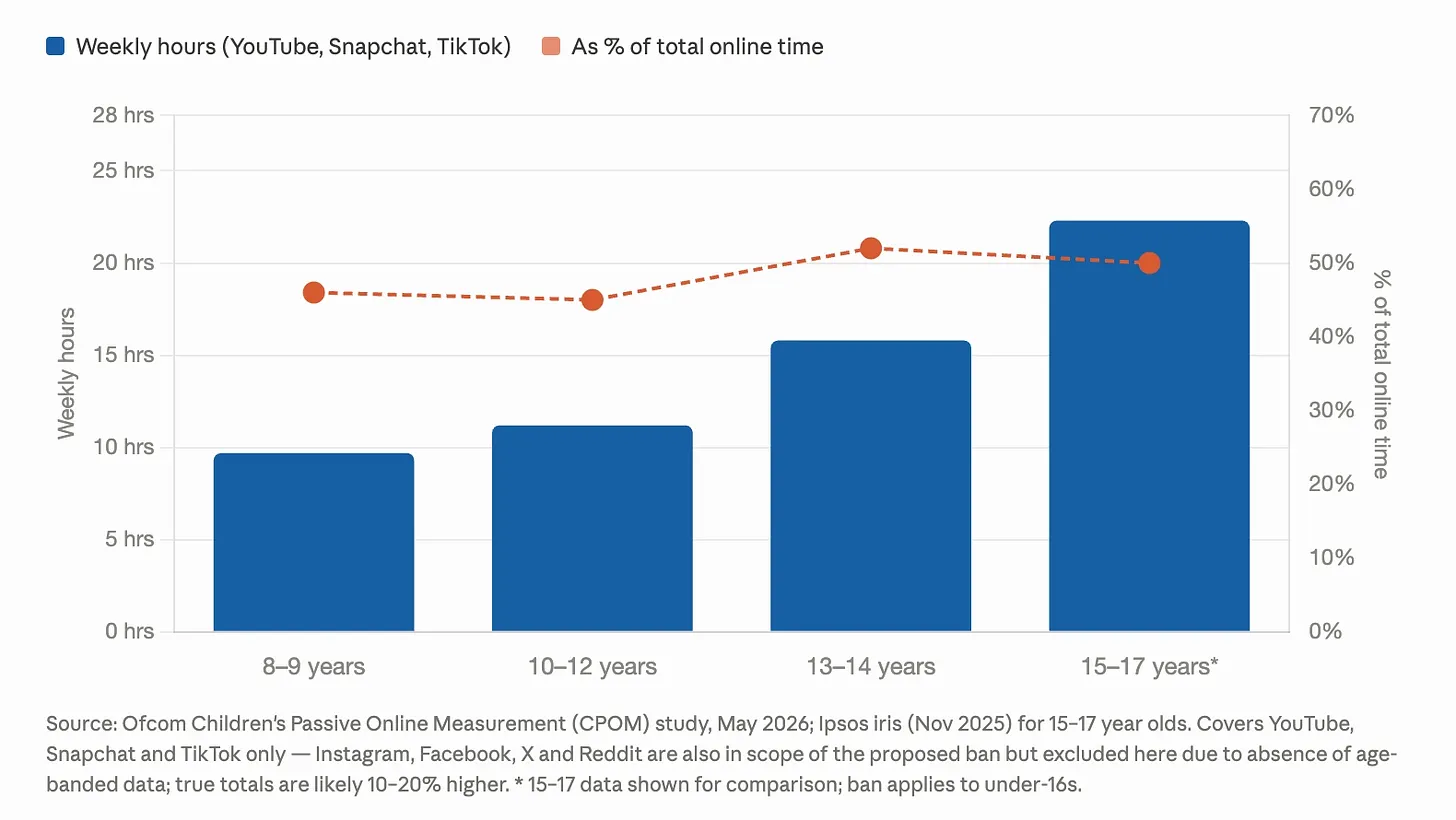
The scale of what a ban is supposed to achieve makes this worse. Ofcom data published in May 2026 shows a 13-14 year old currently spends nearly 16 hours a week – over two hours a day – on just three platforms: YouTube, Snapchat and TikTok. For 15-year-olds the figure rises to over 22 hours a week. The Australian evidence suggests the ban releases almost none of those hours. The habits remain. The platforms remain. The harm remains.
Why it can’t work
Because Meta and Google are not just the companies behind Facebook, Instagram and YouTube. They are online media infrastructure on which businesses depend. They are frontier AI companies which are promising, whether you believe them or not, to deliver a step change in how humans and machines organise the world and, it is hoped, improve living standards.
None of which is good news for avoiding the next Molly Russell catastrophe.
Why the whole argument is on the platforms’ terms
Here is what nobody in that room said, and what yesterday’s announcement didn’t address.
Every proposed solution for ‘dealing with social’ media – the ban, the Online Safety Act, safety by design principles – is a request. Not a demand with real consequences, but a meek request to very large, very rich, and very legally resourced American companies.
“Oh please, will you start behaving now?”
You can’t open a restaurant in this country without passing a health and safety inspection. You don’t get a fine afterwards if your kitchen turns out to be contaminated.
Or cars, which kill 3,200 people every day on average worldwide. No one talks about banning cars despite the many millions that have died or been injured on roads. Nor does anyone politely ask Ford if they would please put seatbelts in their cars or face a fine of up to 10% of their global turnover.
Of course, social media regulation has never worked like that. Platforms launch, cause harm, get asked to stop, litigate, lobby, wait it out.
Just imagine the consequences of the UK banning Meta entirely, or, to exhaust the restaurant analogy, force it to close and only reopen once it cleans up its act. Just for starters, such a move would likely trigger a trade dispute with the US, face judicial review under the Human Rights Act, and alienate the 35 million UK adults on Facebook. This isn’t China; becoming the kind of surveillance state that could actually enforce a blanket ban is not an option any government here (thankfully) will choose.
But there is one mechanism in yesterday’s announcement that is structurally different: the requirement that platforms use ID document scans or face-scanning technology to verify users’ ages. If implemented as a genuine prerequisite – you cannot operate in the UK market until Ofcom has approved your age assurance system – that could be a meaningful step forward for making a under-16s ban workable. For the first time, compliance would come before operation, not after harm.
Whether the government actually builds it that way is another matter entirely. Ofcom has been asked to conduct a “rapid study” of what effective age assurance even means. The details arrive next month, but I won’t be holding my breath.
But here’s what the announcement does reveal, whether Starmer intended it or not: it is an implicit acknowledgment that Meta cannot be controlled at the root. The ban is not regulation. It is a workaround; an attempt to protect a subset of users from a product that the government has quietly accepted it cannot meaningfully constrain.
Meta’s lawyers already know this. So does its share price.
 This article first appeared in Ad-verse Reactions, a newsletter written by independent journalist and consultant Omar Oakes, covering the economics, power structures and unintended consequences shaping advertising and media. You can subscribe to Ad-verse Reactions for regular analysis at omaroakes.substack.com.