Omar Oakes: Trump’s attack on Iran isn’t ‘wag the dog’. It’s so much worse than that

Ayatollah Khamenei is dead. The Supreme Leader of Iran — killed, along with much of his inner circle, in sweeping strikes launched by the United States and Israel.
It was one of the most consequential military actions in decades. At the time of writing, I’m not sure anyone knows what is going to happen next.
This opinion is not about politics, or whether starting yet another war in the Middle East is a good idea.
But I’m asking you to look at the power mechanisms and systems that shape media and advertising — because right now, those systems have put a man with an especially weak grasp of consequence in command of the world’s most powerful military.
Anthony Scaramucci — Trump lackey turned critic — once claimed he had to walk Trump through the plot of Lawrence of Arabia just to hold his attention during a Middle East policy discussion.
That man now has hypersonic missiles. The stakes don’t get any bigger than that.
Which is why it’s important to explain why our industry helped put them in his hands.
Minnesota was the A/B test
We used to take American restraint for granted.When a country possesses overwhelming military superiority — as the US has for decades — restraint is the deal the rest of the world makes with that power. You accept American dominance because American presidents, whatever their flaws, understood the weight of the trigger. Congress is supposed to vote for war. The Cabinet is supposed to remove a president who becomes unfit. The system has brakes.
Those brakes appear to be gone.
Trump clicks his fingers and Nicolas Maduro is captured and whisked from Venezuela. Then Khamenei and his entourage are blown apart. All of it apparently a surprise to everyone except Trump and the top brass.
Is any country Trump doesn’t like now a drone strike away from overnight assassination? What about individuals and groups this president simply dislikes?
These are not hypothetical questions anymore. Look what’s happening in his own country.
Earlier this year, Trump sent thousands of ICE and border patrol agents into Minnesota under Operation Metro Surge — a large-scale enforcement operation targeting undocumented immigrants and alleged fraud.
Look at the format, not just the policy.
Federal agents in tactical gear, led by a thug dressed in what German newspapers were comparing to SS garb. Arrests and stress confrontations captured on camera and for news bulletins and ‘viral’ posts. Clear villains and clear defenders. High contrast. High emotion. Low ambiguity.
Renée Good and Alex Pretti — both US citizens — were gunned down by these federal agents. Pretti, a nurse, was shot in the back several times while on the ground, moments after asking a woman in distress “are you okay?” Good was shot by officers for the heinous crime of… driving away from them.
These were not just unfortunate incidents involving goons with guns. They were the inevitable result of a culture of escalation that had been deliberately cultivated and publicly performed.
And why were these agents in Minnesota in the first place?
Before the surge, a MAGA influencer named Nick Shirley had posted a video about alleged fraud in Minneapolis’ Somali community. It went viral, triggered partisan outrage across the right, and identified a pressure point — a community, a grievance, a visual. Political actors moved directly toward it.
You don’t need to prove a conspiracy to see how this works. Viral content identifies a flashpoint. Power moves to the flashpoint. The operation gets filmed. The footage travels. The cycle intensifies.
The clashes in Minnesota were supposed to happen. The federal agents and their heavy-handedness were content. Arrests as clips. Confrontation as the product.
The only calculation for Trump is ‘will my people like this and will my enemies hate this’?
And, at its heart, the monumental act of attacking Iran is much the same.
This is what the system teaches
Marshall McLuhan’s famous line — the medium is the message — is usually treated as a metaphor.
But here, it’s a way of actually governing.
Social media platforms are not neutral. They’re built to reward what makes people react — anger, fear, pride, outrage. Politicians, like every influencer chasing likes and ad revenue, get conditioned by the same feedback loops. They notice what works. They do more of it.
So why bother with quiet diplomacy when it doesn’t trend? Why seek the centre ground when compromise doesn’t spike?
You get shock instead. Dominance. Escalation. Interruption — and in an attention economy, interruption is power.
This is not about cynical calculation by Trump, Farage, Le Pen or any particular demagogue. The system teaches the behaviour whether or not the actor understands the lesson.
Minnesota was the logic at street level. Iran is the same rationale, with a different kind of firepower.
The mechanism is bigger than the man
The reflex reading of the Iran strikes is “wag the dog” — a reference to the 1997 film in which a US president fabricates a war to distract from a domestic scandal. The phrase stuck because the film released within weeks of Bill Clinton launching missile strikes on Sudan and Afghanistan during an impeachment crisis.
There’s no doubt Trump would like you to forget that he appears in the Epstein files hundreds of thousands of times. The distraction motive is real.
And yet it’s still too small an explanation. It makes this a story about one bad actor buying himself a news cycle. Fix the actor, fix the problem.
The fuller, more unsettling story is this.
Populist politics in the social media age aren’t about policy. It’s about the size of the play. The daily disruption. The headline that makes yesterday’s headline vanish.
The politics our democracies used to reward — serious people, arguing seriously, about the machinery of government — is now algorithmically invisible.
What replaces it is a permanent competition for the most radical, most disruptive, most attention-saturating move available. We’re sending armed troops into Minnesota to round up immigrants. We don’t like the election result so we’ll send a mob to overturn it. We’re getting rid of dictators we don’t like because we can show how uncompromisingly strong our military is, without bothering to explain (or even contemplate) what the actual purpose is.
In other words, there must always be a big show of conflict to keep our social media audience ‘engaged’. Each show must be bigger than the last, because the algorithm doesn’t reward repetition — it rewards escalation.
In that context, a military strike isn’t a foreign policy decision that happens to generate coverage.
It’s the ultimate content drop. Nothing competes with it. Nothing trends alongside it. It collapses every other story in the cycle instantaneously.
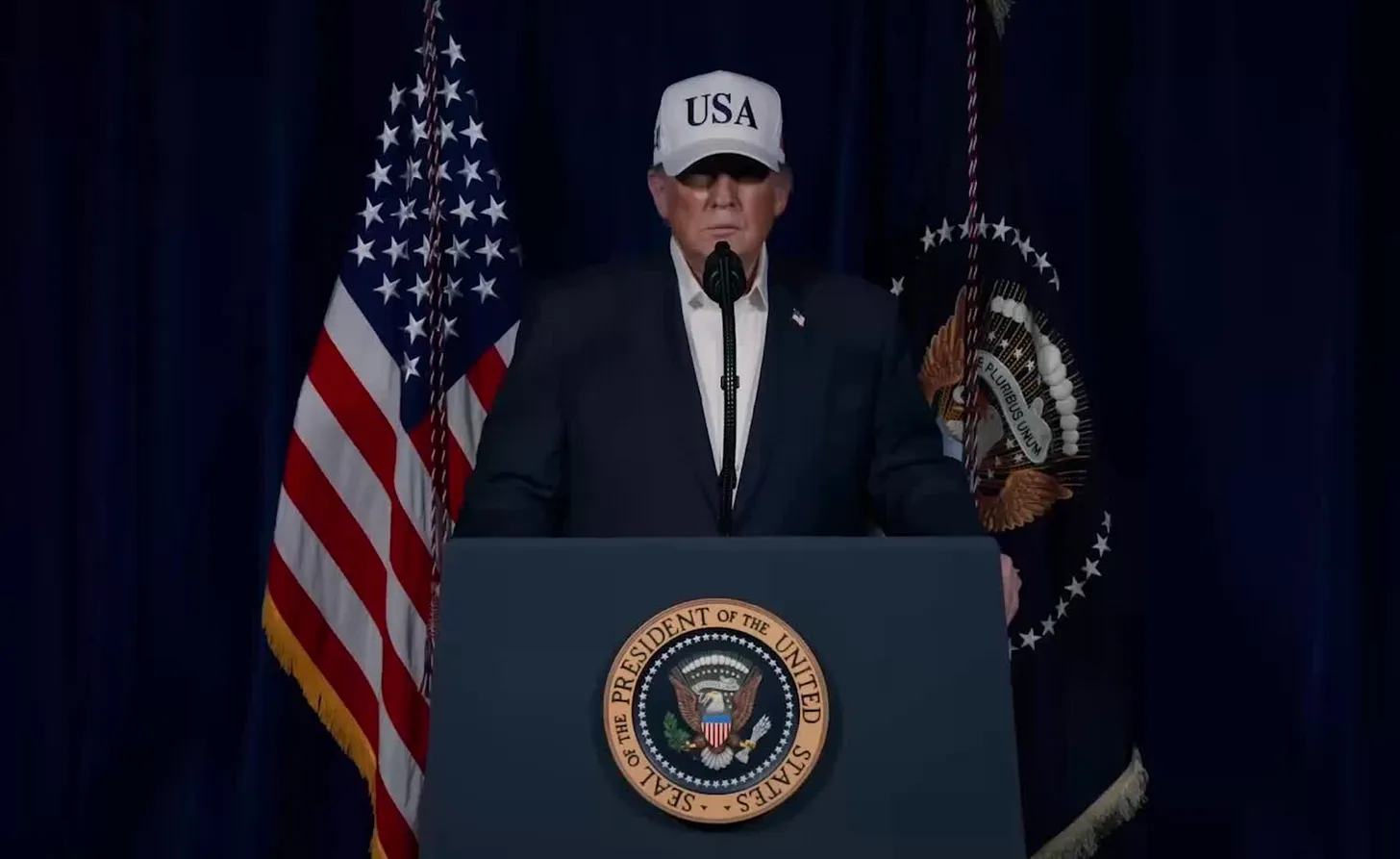
And that’s exactly how Trump announced it in the early hours of Saturday. Not from the Oval Office — not with the gravity that the assassination of a head of state demands — but on, er, Truth Social. A poorly lit video, shot in a baseball cap, flung out on his personal blog like he was hawking Trump Steaks again. He couldn’t even be bothered to put on a tie or put his ridiculous combover through the usual two cans of hair spray.
And here is the part that should make you genuinely cold.
Iran wasn’t attacked because it posed a serious threat. Paradoxically, it was struck partly because it didn’t.
A genuinely powerful adversary creates risk, negotiation, consequences — none of which are ‘good content’. But a weakened Iran — its proxies degraded, its economy strangled, its air defences already compromised — is a manageable target. One that produces spectacular imagery without an unmanageable response.
The cruel irony is that the only way Iran now damages anyone is in retaliation to these strikes. The attack didn’t neutralise a threat. It created one. But that retaliation? That’s just the second wave of ‘content’.
The Iranian people are the victims of a content strategy.
We built this
Our industry should recognise we are not bystanders to this.
The advertising industry funded the optimisation engines. We plugged brand budgets into platforms that monetise visibility, virality and emotional intensity. We professionalised engagement metrics. We made shareability valuable. We turned interruption into a premium format.
Of course we didn’t know we would reshape how military decisions get made. No media buyer sat down and decided to restructure the incentives of geopolitical power.
But we built the architecture that made spectacle the highest-performing currency in public life.
Trump didn’t invent this populist playbook but he’s the most fluent reader of this system.
Which is why the question that should keep you up at night isn’t what Trump does next. It’s what the next person learns from watching what works. Someone smarter. More disciplined. Willing to deploy the same logic with greater patience and fewer visible seams.
We used to think the unthinkable was unthinkable because rational actors would stop before it. But this system doesn’t produce rational actors. It produces optimised ones.
And optimised actors, given enough runway, don’t stop at the last responsible moment.
They stop when there’s nothing left to escalate to.
 This article first appeared in Ad-verse Reactions, a newsletter written by independent journalist and consultant Omar Oakes, covering the economics, power structures and unintended consequences shaping advertising and media. You can subscribe to Ad-verse Reactions for regular analysis at omaroakes.substack.com.