
A little under three years ago, it gave me great (professional) pleasure to publish this line of reportage:
“The entire panel appears to squirm in their seats while discussing this raunchy music video, which begins with a woman’s body symbolising a beach, and a female sex organ depicted as fresh water. Throughout the video, [Busta] Rhymes and fellow rapper Bia pair dance, vibe, and flirt with beachgoers.”
The feature in question, written during my time as editor of The Media Leader, was published when BARB, the UK TV audience measurement company, was in the early stages of trying to bring YouTube into its reporting system.
The challenge BARB faced then (and now) is this: even if you can measure and publish data about everything that is watched on YouTube, not all content published on YouTube is ‘fit for TV’.
Most content published every day on YouTube would, in fact, fail the ‘fit for TV’ standard.
That’s because it lacks at least one of the following:
- editorial oversight
- clear separation between editorial and advertising
- high enough production standards
- adequate brand safety or suitability
So BARB got a bunch of industry experts to watch a range of YouTube classics, including MrBeast and Chicken Shop Date, and rate how ‘fit for TV’ they were.
Why Busta Rhymes’ Beach Ball was my favourite of the bunch was because, despite being soft-porn trash, it is indeed ‘fit for TV’, while comparatively benign fare like ‘Every Book I’m Reading in June’ and a product review for Air Up water bottles would fail the test.
Broadcast is from Venus, YouTube is from Mars
- commissioned
- regulated
- scheduled
- advertiser-structured
- compliance-audited.
Meanwhile, YouTube is
- platform-led
- creator-driven
- algorithmically-surfaced
- commercially integrated at creator level (native ads)
- governed by platform policies, not industry regulation
And yet today, as was true three years ago, you can watch all of the above on a television set in your living room because the TV is now connected to the internet.
This is important to remember when reading BARB’s new What People Watched in 2025 report, which leads with an important finding that more than half (54%) of YouTube viewing is now on a TV set.
And the audience is broadening: YouTube viewing is “prevalent in all age cohorts” and BARB notes that TV-set reach among 55+ viewers has almost doubled since 2022.
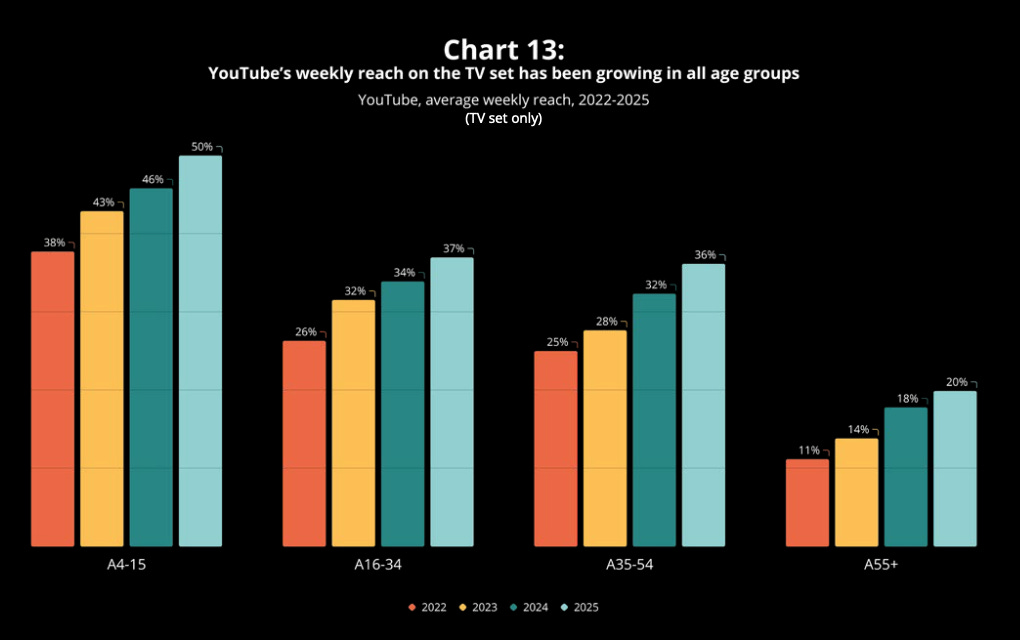
So the caricature of YouTube as merely “kids on tablets” is obsolete. And yet the same data that proves YouTube’s maturity also proves its difference.
The screen has converged. Behaviour hasn’t.
If you stop at the headline figure — 54% of YouTube viewing on TV sets — you might conclude that YouTube has finally crossed the Rubicon. The big screen was historically the last redoubt of broadcast power, but now it’s algorithm territory.
But the detail tells a subtler story.
BARB’s navigation analysis shows that YouTube is the “fourth most-viewed navigation platform” on the TV set. When people switch on their TV sets, YouTube competes with Freeview, Sky, smart TV interfaces, Netflix and others.
However, looking at TV set viewing during different times of the day is particularly revealing.
YouTube’s share of being first destination at switch-on “ranges from 10 to 15% for clock hours outside peak, but that dips into single figures during the evening peak of 7–11pm.”
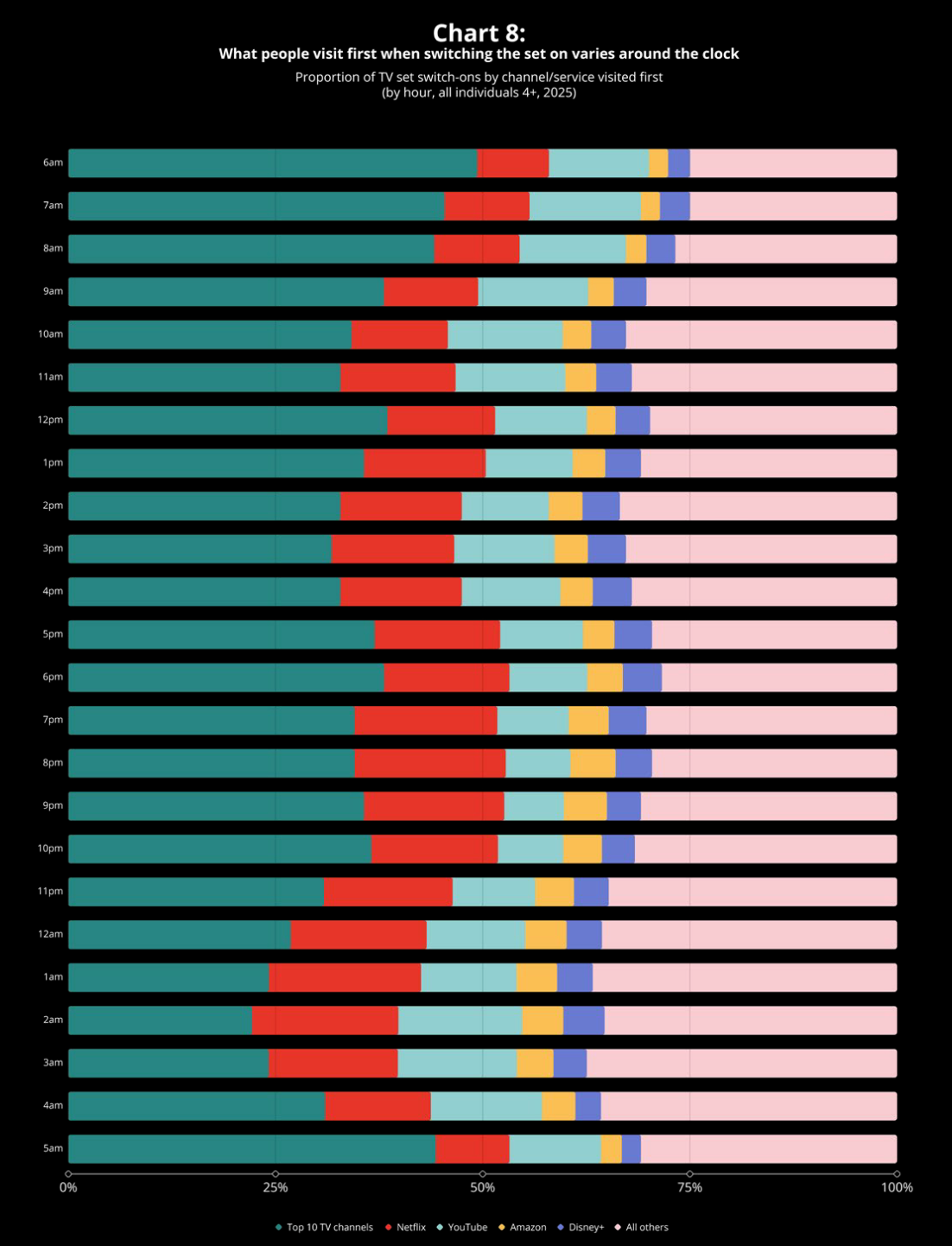
For UK broadcasters, 81% of viewing to their content still happens on the day of broadcast. That gravitational pull towards shared, synchronous viewing remains intact. YouTube’s viewing curve looks very different.
In other words: when Britain sits down for prime time, very few of us are curling up on the sofa to watch MrBeast and Sidemen.
Because ‘television’ is not just what comes out of a certain size of device. Because it carries expectations of content standards, viewers adapt their behaviour in line with those expectations.
UK broadcasters are required to separate advertising from editorial, to schedule programming within regulated time bands, and to maintain compliance oversight before and after transmission. That architecture produces predictability: in tone, in timing, and in commercial interruption. Viewers know what they are getting at 8pm on BBC One in a way they do not when opening YouTube.
Over time, that predictability shapes behaviour.
Which is why linear broadcasters still anchor shared evening viewing. Netflix and other streamers have built their own peak rhythms around episodic drops and event launches. Appointment viewing may have weakened, but it has not vanished.
YouTube, by contrast, is strongest mid-morning, late night, and outside classic peak. It thrives outside peak hours, in the margins of the broadcast day.
Same screen. Different species.
Cross-generational — but not evenly weighted
The other uncomfortable fact that BARB confirms is compositional.
The chart (below) shows YouTube’s TV-set viewing over-indexing by 72% among 4- to 15-year-olds versus their share of the UK population.
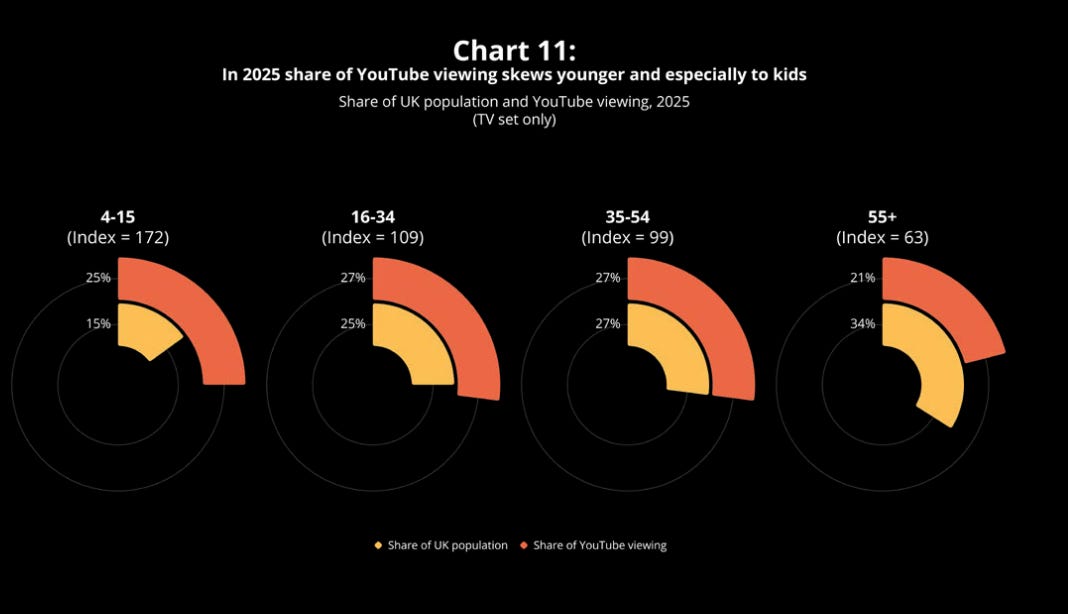
That does not mean children are the majority of total YouTube viewing on TV sets. But it does mean something structurally important: YouTube’s living-room footprint is disproportionately child-skewed.
That matters commercially. An audience that is structurally over-represented among under-16s is not economically the same as a broadcaster whose peak-time audiences skew 35+. Reach may look comparable in aggregate, but audience composition drives pricing, brand suitability and regulatory exposure.
At the same time, older audiences are coming in fast. The report highlights rapid growth in 55+ reach.
So, while YouTube is not a youth ghetto, nor is it a mirror of broadcast demographics.
For children, it is often long-form cartoons (Peppa Pig, Miss Rachel, CocoMelon), creator content, looping comfort videos. For adults, it is podcasts, clips, niche interests, news fragments, music, tutorials. For many households, it is a utility — something to occupy, accompany, or explore.
Television, by contrast, remains structurally organised around programmes, schedules, and shared events. Even on-demand, Netflix and Disney+ revolve around episodic series and film libraries. Their release cycles still create collective moments.
YouTube creates moments too — but algorithmically, not editorially.
Navigation gives the game away
Perhaps the most telling detail in the report is how YouTube is categorised.
It is not treated merely as a channel; it is described as a navigation platform. That’s a subtle but profound distinction.
Broadcast channels are destinations: you switch to BBC One or ITV1 because ‘something is on’. Streamers are increasingly destinations too: you open Netflix because you intend to watch a series.
But YouTube is often something else. You open it to see what’s there. To search. To browse. To let the recommendation engine decide.
That inversion changes everything — from ad placement to content rhythm to expectations of interruption.
If you assume equivalence — that a YouTube TV-set impression is functionally the same as a BBC One peak-time spot — you are ignoring the behavioural context in which it sits.
Even Netflix, with its algorithmic interface, operates within a commissioned, budgeted and compliance-cleared production model. Episodes are constructed around ad breaks or subscription tiers. YouTube’s commercial logic is decentralised at creator level. That distinction is not cosmetic.
Context shapes our attention. Our attention shapes our memory. And our memory shapes value.
Measurement makes that visible. Which is why, in case you haven’t noticed, I’m writing about measurement a lot as I chronicle how power and influence are changing in advertising and media.
When independent measurement places YouTube in the same frame as broadcasters and streamers, the difference becomes visible. And difference complicates equivalence claims like “YouTube is the new TV”.
Why independent measurement still matters
The debate about whether YouTube “is TV” has never been about screens alone. It’s about comparability.
Of course no medium stands still. The shift from analogue to digital has reshaped television in myriad ways, but these changes happened within a regulated and commissioned framework. Incidentally, BARB’s report also shows that streaming viewership is growing on TV sets for all providers… it would be interesting to know how much YouTube indirectly benefits as more consumers watch iPlayer and ITVX on their TVs (all video channels are curated on modern TVs as apps).
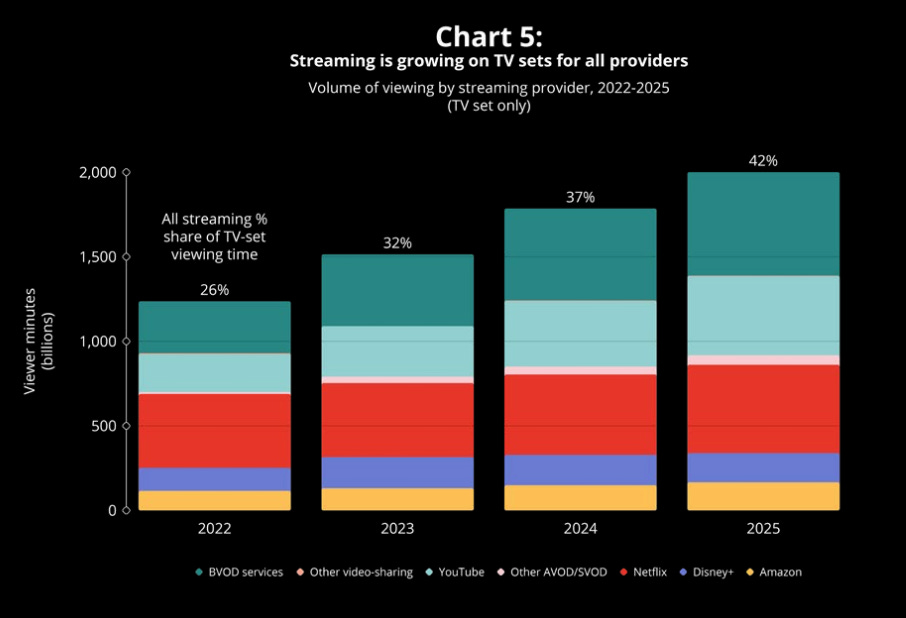
But YouTube’s architecture is different at the root.
If YouTube is competing for television budgets — and it is — then advertisers deserve to understand not just reach totals, but behavioural patterns. BARB’s panel-based system, imperfect but transparent, puts those variables in the same frame as broadcast and streamers.
What this report shows is not that YouTube viewing is huge. Even with all obfuscation around what an impression means, we know directionally that a lot of people are watching YouTube content, young and old.
But the data suggests something more nuanced: YouTube has moved into the living room but it has not become television.
Conflating the two may simplify a pitch deck. But it doesn’t simplify the buying decision.
 This article first appeared in Ad-verse Reactions, a newsletter written by independent journalist and consultant Omar Oakes, covering the economics, power structures and unintended consequences shaping advertising and media. You can subscribe to Ad-verse Reactions for regular analysis at omaroakes.substack.com.