

Six uncomfortable truths from a panel that tried to answer that question.
Today I’m publishing a new word: megacombo.
I propose that, from now on, megacombo replaces the awful jargonistic term: sustainability.
Because sustainability is the worst kind of word: a boring, technical term for a beautiful idea. Megacombo will better represent this idea, that systems, such as life on planet earth, have a rich enough mix of diversity and layers of strength that it can sustain over a long, indefinite period. It is lasting and internally self-correcting when things get out of balance. The nature of life itself: a megacombo.
This is the idea that drives my fascination with media and advertising: the clear, alarming and urgent preoccuapation that whatever this industry is doing is unsustainable. Far from being a megacombo, it is becoming monolithic. The map has shrunk in terms of companies on the buy and sell side. Fewer companies, fewer leaders, fewer personalities, and fewer ideas.
Like any lasting ecosystem, a media and advertising market can only remain strong through diversity: a spectrum of differentiated buyers and sellers that morph into different shapes and sizes as culture and technology changes.
While nature has extremely strong tools for self-correcting imbalances, a human-made construct like a market needs human intervention to ensure things don’t go too awry. Or unsustainable. Or anti-megacombo.
This argument, as I put forward in a recent Media Leader column, is essentially my evolving view of this market and it’s what drives my journalism at the moment. The weakening of our megacombo is an unfolding catastrophe that threatens so much of the entertainment, journalism, publishing and public discourse that were taken for granted when I was a child in the late 20th Century. You don’t need to read Yuval Noah Harari’s Nexus (although you really should…) to see that the proliferation of online media has coincided with the rise in authoritarianism and a general flatlining in business productivity.
This shouldn’t be a controversial view, but being anti-tech tends to run against a pro-business narrative because people constantly make this category error: they associate technological progress with economic progress. See here for my argument (or rather, Charlie Munger’s argument) for why tech can be good for consumers but is generally bad for businesses.
But the thing is, our industry is pretty poor at asking itself existential questions like this. Part of this is structural: creative industries are, for very good reasons, very sensitive about self-regulation. We all instinctively recoil at the idea of governments or other bureaucrats putting limits on free expression, not to mention free enterprise.
The other part reveals itself after many years of studying the people who work in this industry: we are an industry of nomads and travellers. Very few of us wanted to sell display ads or create slide decks about iROAS when we were children; this industry generally attracts bright and commercially savvy people who ‘just fall into’ media or marketing. This means few of us have strong preconceptions of what this industry should be or ought to be; we are geared to go with the flow, that uncertain momentum that carried us into this sector in the first place.
This complacency has made us vulnerable to the knotweed of Big Tech, which has been allowed to invade this industry at will without any real attempt to ask the simplest of questions: is any of this actually sustainable?
That’s the big question we must keep asking now. It’s one of the key questions the Advertising Who Cares initiative posed earlier this month at their Who Cares Wins? event in central London, hosted by Prospect magazine.
Content, that other stale, jargonistic term we use to describe the words, sounds and pictures that makes all of our commercial endeavours possible, is at the forefront of this shrinking of sustainability. You only need to visit Los Angeles to see how America’s engine of the entertainment industry has been hollowed out, or walk around London’s Soho, where you’d be lucky to spot anyone who works in advertising these days (they’ve all presumably migrated at home, spending most of the day perfecting LinkedIn posts that no one will see).
AWC, or even the sort of pieces I find myself writing these days, shouldn’t exist. But these conversations have become necessary because our industry lacks the infrastructure of self-correction that makes our industry sustainable. Or megacombo-able.
Let me explain how this impacts content, via six important findings from my excellent panel that day. My panelists were:
- Dominic Ponsford, editor-in-chief of Press Gazette
- Mel Leach, CEO of South Shore Productions
- Stephen Colegrave, co-founder of Byline Times,
- and Damian Collins, former MP, DCMS minister and DCMS select committee chair.
1. Scary numbers. So why aren’t we more scared?
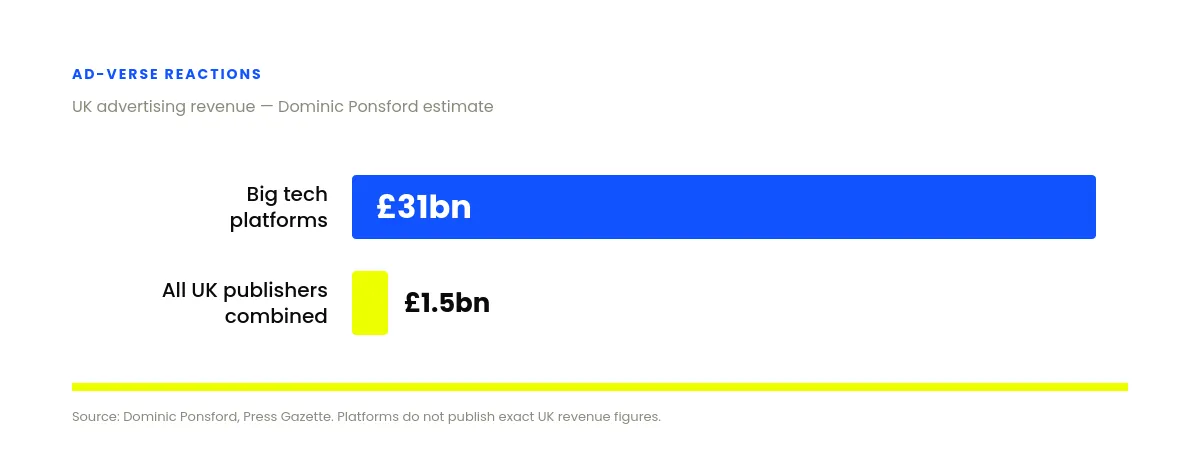
Ponsford opened with figures the industry knows but rarely acknowledges with appropriate alarm: £31bn of £46bn in UK ad spend goes to the platforms.Compare that to every publisher combined: £1.5bn.
WARC’s figures tell a similar story: over the last two decades, total adspend on magazine and newsbrand media has fallen by a factor of 7.6x: from £9.2bn in 2005 to just £1.2bn at the end of 2025.
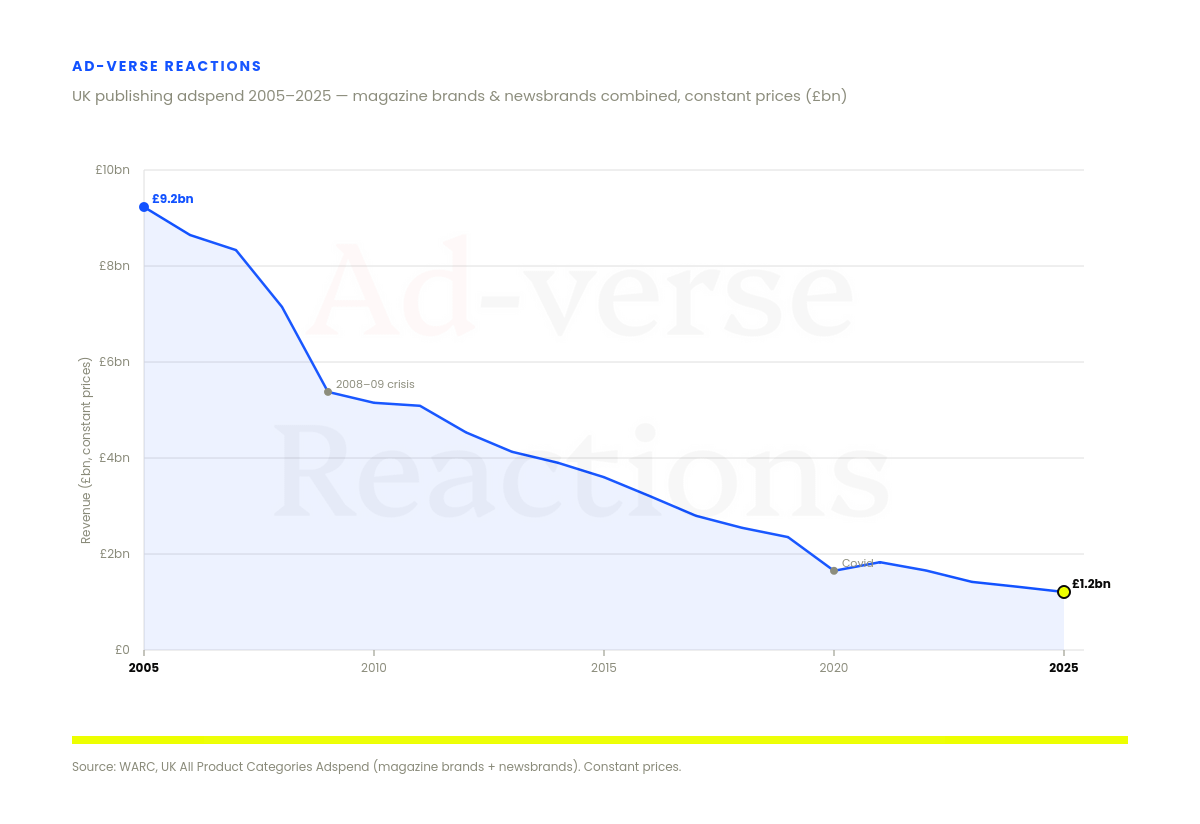
While many won’t shed a tear that the publications they don’t like have either been hollowed out or starved completely during this famine, Ponsford reminds us that advertising has, since the Industrial Revolution, subsidised the messy, incomplete, but essential public service that we call journalism.
“[Advertising] enabled democracy to happen; the fact that we had journalists who told people what went on, and it was subsidised.”
But now, he added, we have just “10%” of people in the UK who pay for online news. What of the other 90%?
“Well, who knows? You’ve got the BBC, but if the BBC is the only show in town, we’ll all love it a little bit less, I think.”
He went on: “You are getting an information-rich elite that people are willing to pay for information, but in terms of ‘mass media’… there are a lot of kind of polemicists and conspiracy theorists who do really, really well on YouTube.”
The antithesis of quality media: unchecked content garbage published by platforms whose editorial decisions are automated instead of professionalised.
And it’s not because we’ve all just accepted that this is how content should be in the smartphone-internet age. That publishing on four-inch screens instead of print presses should mean publishers’ revenue is decimated and consumers get a much worse product. And the platforms who created these now media experiences should be so richly rewarded for what they’ve built for us.
Instead, according to Collins, we are all unsatisfied, and yet: “the industry won’t speak up about it, because it can’t afford to, because its coffers are being stuffed by these platforms all the time…. there’s a reluctance… to call out Google [and] Amazon, because they are the dominant commercial players in this industry.”
So not ignorance, but structural cowardice. Collins didn’t name names: was he talking about trade bodies? Agencies? Trade journalists? All of those who should stand up for quality content but are financially dependent on the platforms they’d need to challenge.
2. YouTube and the shadow system
Then Collins made what was arguably the session’s most consequential observation.
YouTube is already the UK’s biggest distributor of television content, yet broadcasters must surrender 45% of ad revenue to distribute on it, abide by Ofcom standards, and compete for prominence in an algorithm they don’t control. This is important for two reasons:
Firstly, the premise is not true! YouTube is not the UK’s biggest distributor of TV content, no matter how you define “distributor of television”.
If you mean traditional scheduled broadcast content – dramas, documentaries, news, commissioned formats – the BBC iPlayer, ITVX, Channel 4, and Sky collectively distribute far more of that than YouTube does. If you mean “video content watched on a television set,” YouTube’s own data shows it is the most-watched streaming app on UK smart TVs by time spent, but that includes user-generated content, music videos, vlogs, and everything else that reasonable people wouldn’t call television.
It’s really important to make that clear because, given the way YouTube went round calling itself “the new TV” last year, this misunderstanding creates confusion about the scale of what’s going on in our industry.
But secondly, Collins was making real and important point. If YouTube is the largest single platform by volume of video consumption in the UK, we now have a shadow TV system in which the regulatory framework was written for a world that no longer exists.
That’s because, as Collins points out: “for the consumer at home, this is one box on the wall where everything is coming in… that has got a smaller audience than a YouTuber, is largely unregulated. I mean, from a consumer point of view, that is nonsense.”
“What does it mean to be a public broadcaster with a broadcasting license with various codes you have to abide by, if you’re reaching your customer through the same medium, where people don’t really have to do very many of these things at all?”
Collins’s big question, which is true for all platforms, is this: “if YouTube does become television, then do we have to regard it almost like a public utility and regulate it as such?”
3. Content: the ‘top of the content funnel’ is a public good
We’re very good at describing a marketing funnel in advertising: creative ideas sit at the top of the funnel to create long-term brand-building associations in consumers mins, while bottom-funnel activity converts to sale the people who are already interested in your product.
Leach applied this funnel thinking to content, which is a useful frame for why the content ecosystem is suffering even though, if you only look at headline statistics – £124bn, 2.4 million jobs – the creative sector appears to be in good health.
Her examples of recent UK hits – Mr Bates vs the Post Office, Dirty Business – are evidence of what the top of the funnel actually does: it creates the cultural texture against which advertising finds its meaning. Kevin Lygo, ITV’s director of television, told AWC’s annual conference in November that Mr Bates would not have been made if ITV were not an ad-funded broadcaster. While Mr Bates had an enormous national impact with its cutting dramatisation of the UK Post Office scandal, it would be very unlikely to attract a production green light from a Netflix or Warner Bros.
Global streamers don’t make those shows. They want global content, supplemented with domestic content that they can reliably procure from domestic broadcasters.
Leach said: “If money continues to flow to digital and out of our terrestrial PSBs, then there is a danger that all of the content that reflects us back as a society will just simply be lost because the terrestrials are not going to be able to afford to fund it.
“Global streamers are called global streamers for a reason, they want global content. They’re not massively interested in domestic conversations, and some of those programmes are really significant and important.”
You could argue that streamers currently have the best of both worlds: they can fight a global streaming arms race (i.e. produce and commission mostly American-made TV and film for global export), which ‘windowing’ domestic content via deals with the likes of ITV, which currently swaps some content with DisneyPlus on ITVX.
So you see how this is not ‘streamer bad, broadcaster good’. It’s about sustainability. Streamers need the BBC, ITV, Channel 4, and the production companies they either own, operate or commission, to keep the content funnel filled with diverse content.
In the real world, most of us don’t want to watch Friends reruns and Marvel movies ad nauseam. We want stories that reflect our culture, which remains rooted in our nations and communities, which remain stubbornly analogue with their nuances, blurred edges and unpredictability.
Without media owners and production companies that are incentivised to tell national and regional stories, a huge part of what makes TV “quality” would be under threat.
4. Britain’s creative lead is a legacy position. But we’re spending it down.
But Leach’s most striking evidence was commercial rather than cultural.
“We probably need to look at the way that we incentivise domestic production in the UK. We’re not the most competitive in the world anymore, and that is a problem. We don’t have incentives for British broadcasters to buy original British IP.”
The UK is the world’s number-one format exporter, but the conditions that produced that position are being dismantled in real time.
This is partly because, in this global content race, some countries are adding grease to the track: Ireland, Leech said, has a tax credit threshold of £250k versus the UK’s £1m-per-hour drama requirement. The result: production is physically leaving the country. All of Fox’s [TV] entertainment is now made in Ireland specifically because of that tax break, she added.
What’s more, Leech’s own next global format won’t be made here: “we will actually not produce it in the UK, we will produce it in either Belgium or Amsterdam, because it’s much more affordable.”
5. Platform dependency is a trap. Even the escapees can’t fully escape.
Stephen Colegrave’s Byline Times story was the most vivid case study in the session. A freemium model built on social traffic, working well… until it wasn’t.
Byline Times is a reader and shareholder-funded print-first newspaper that aimed to break the dependence that publishers have always had on advertisers, in order to rebalance the editorial concerns from corporations to people. All editors (myself included when I was one), might crow about editorial ‘independence’ and the importance of ‘church and state’, but this is a tough balance to strike.
Meanwhile the legacy publishers have all, at some point in their journey of ‘digital transformation, been burnt by the platforms, whether it’s due to sudden algorithm or product changes, or a gradual metamorphosis from friend to frenemy to outright antagonist.
Byline, for its part, grew up on Twitter (now X). But then, Cosgrove recalled, traffic from X and Facebook dropped 90% almost overnight. They migrated to Apple News, BlueSky, Threads, and Substack, but only got back roughly half of that referral traffic.
Ponsford invoked Private Eye, a UK publishing institution, which still maintains a a 250,000 circulation and profit margin despite never having gone digital.
But the lesson isn’t “don’t go digital.” We’re never going back to a world of pulps and printing presses and pretend that iPads, Kindles and smartphones don’t exist.
Colegrave explained: “I think people don’t realise the extent to which publishers and news organisations rely on social media to actually promote and give them traffic… that is a real issue that’s going on now. There’s no regulation about that.”
Byline’s commercial model – subscriptions (now 60,000), events, shareholder-readers – is genuinely compelling and worth holding up as a direction of travel. But the structural headwinds publishers face are intensifying, not easing. The path that Byline took in 2019 is much harder to walk in 2026.
So much so that Colegrave admitted that it would now be impossible to launch Byline Times today.
Once you’ve built on someone else’s land, you can’t choose when they evict you.
6. Self-regulation had a theory of the case. That theory is now broken.
Collins offered the sharpest historical framing of the session: Self-regulation worked in the 20th century because everyone at the table needed the market to be trusted. But now they don’t.
He said: “This industry is run really the way it was 100 years ago… Lord Beaverbrook would sit down for dinner with Lord Northcliffe, and they sorted it all out… because it was in everyone’s interests to have a trusted marketplace. Now we see the biggest section of that trusted marketplace dominated by companies that don’t abide by those rules, and no one can make them.”
That’s because Lords Beaverbrook and Northcliffe both had skin in the game. The platforms don’t. Or rather, their skin is large enough that they can absorb the jeopardy.
Tim Cowen, co-founder of Movement for an Open Web, went further with a chilling comment from the audience: “You can’t run a business in a digital economy without being found in Google. If you make a complaint about Google, you are likely as not going to be subject to retaliation in your business’s [search] history. That should be a cause for major political concern.”
In March, I documented the various ways in which self-regulation has become embarrassing in the UK. For those of us who still cling on to the belief that government should not be in the business of regulating free expression, it’s a troubling time because that free expression is being published on platforms where ad fraud, misinformation and AI slop don’t just ‘surface’ but, increasingly predominate.
And finally: stuffed coffers
There is, it turns out, no self-regulation because there is no self to self-regulate. As media has become capital-intensive, we are now faced with the uncomfortable 21st Century dilemma of becoming much tougher on regulating content as if we are issuing licences to practice medicine or law. But what other way is there, when the media is created by high-velocity content machines and not people?
Once again, this is an area where trade bodies are meant to protect industry from self-regulation by providing that forum for its members to find and correct problems without the government sticking its oar in.
But instead, there is no longer self-regulation because the ‘self’ is dominated by Big Tech, the very ones who have given these us these new regulation problems.
“The industry won’t speak up about [platform dominance] because it can’t afford to,” Collins said. “Its coffers are being stuffed by these platforms all the time.”
Which isn’t a new thing. This long-established ‘stuffing’ practice even has its own jargonistic term: industry capture.
 This article first appeared in Ad-verse Reactions, a newsletter written by independent journalist and consultant Omar Oakes, covering the economics, power structures and unintended consequences shaping advertising and media. You can subscribe to Ad-verse Reactions for regular analysis at omaroakes.substack.com.