
Omar Oakes: Netflix isn’t becoming YouTube, but definitely YouTube-ish

Podcasts, a maybe-free tier, and a stock market that isn’t convinced: what Netflix’s earnings call actually revealed.
Not so long ago, the idea of avoiding social media was unthinkable for anyone with ambitions to succeed in media or advertising.
The rate at which things can change in media and advertising these days is staggering.
Just seven months ago, Netflix told the world it was buying one of the world’s biggest media companies, Warner Bros. Discovery, for $83bn.
Then, co-CEO Greg Peters justified the acquisition this way: “With our global reach and proven business model, we can introduce a broader audience to the worlds they create – giving our members more options, attracting more fans to our best-in-class streaming service, strengthening the entire entertainment industry and creating more value for shareholders.”
That deal was scuppered by Paramount bending over backwards to acquire WBD for itself. CEO David Ellison may have bent forwards, too, if this week’s lawsuit allegations around he and his father’s relationship with Donald Trump is to be believed…
And last night, after reporting its second-quarter earnings, Netflix seems to have fully opted for Plan B: not ‘become YouTube’, but certainly become more like a platform as increasing user growth and watch time without the treasure trove of content that acquiring WBD would have bestowed.
Which means Netflix is being pulled onto unfamiliar terrain: daytime viewing, mobile screens, creator relationships, and – however reluctantly – the idea of giving content away for free. Netflix competing on YouTube’s terms, on YouTube’s turf, using YouTube’s talent pool.
In short, become ‘YouTube-ish’.
The platform bet
For 19 years, Netflix’s entire identity rested on one idea: the commissioned, budgeted, compliance-cleared show, dropped all at once, built around a season and a schedule. That’s the model that made appointment viewing out of an on-demand service; a neat trick, and one worth remembering.
Because this quarter Netflix admitted it’s building something that doesn’t work like that at all.
It reported revenue of $12.56bn, up 13% year-on-year, just shy of analyst consensus. Operating margin held at 33.4%, ahead of the company’s own forecast. Diluted earnings per share came in at $0.80, beating the $0.79 analysts had expected. Guidance for the third quarter points to a slowdown to 12% revenue growth, which Netflix attributes to prior-year comparisons rather than any change in the underlying business.
Co-CEO Ted Sarandos told analysts that Netflix’s video podcasts are “out-indexing on mobile,” a fairly bloodless way of saying something quite significant: this content is winning specifically in the hours and on the devices Netflix historically didn’t own. Most Netflix viewing happens in the evening, on a TV, as part of a household ritual. Going forward, podcasts featuring Jay Shetty, Martha Stewart, and a rotating cast of creators are filling the other half of the day: the commute, the desk, the phone propped against a coffee cup.
Netflix calls this incremental. That’s probably true. It’s also the audience YouTube has dominated for the better part of two decades.
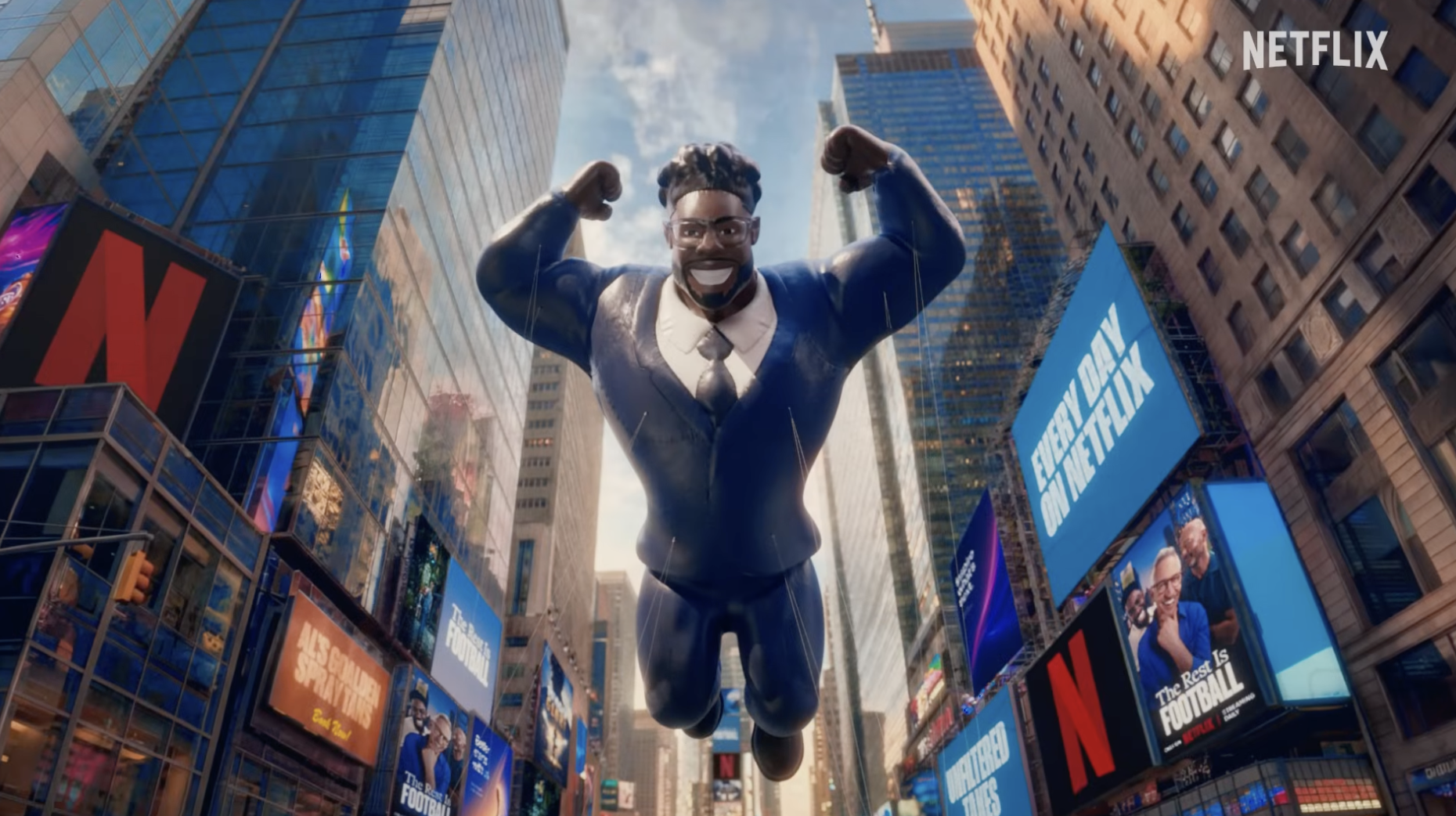
But the streaming giant also tried to have its cake and eat it. Having very deliberately tried to leverage worldwide interest in the FIFA Men’s World Cup by bringing on board Goalhanger’s The Rest is Football (pictured, above), it blamed the same tournament for Q2 being a tough quarter. View hours grew 2% in the first half of 2026, roughly 97bn hours watched between January and June, an extra 1.5bn hours versus the same period last year. That’s a slight acceleration on 2025’s full-year growth rate of 1.5%
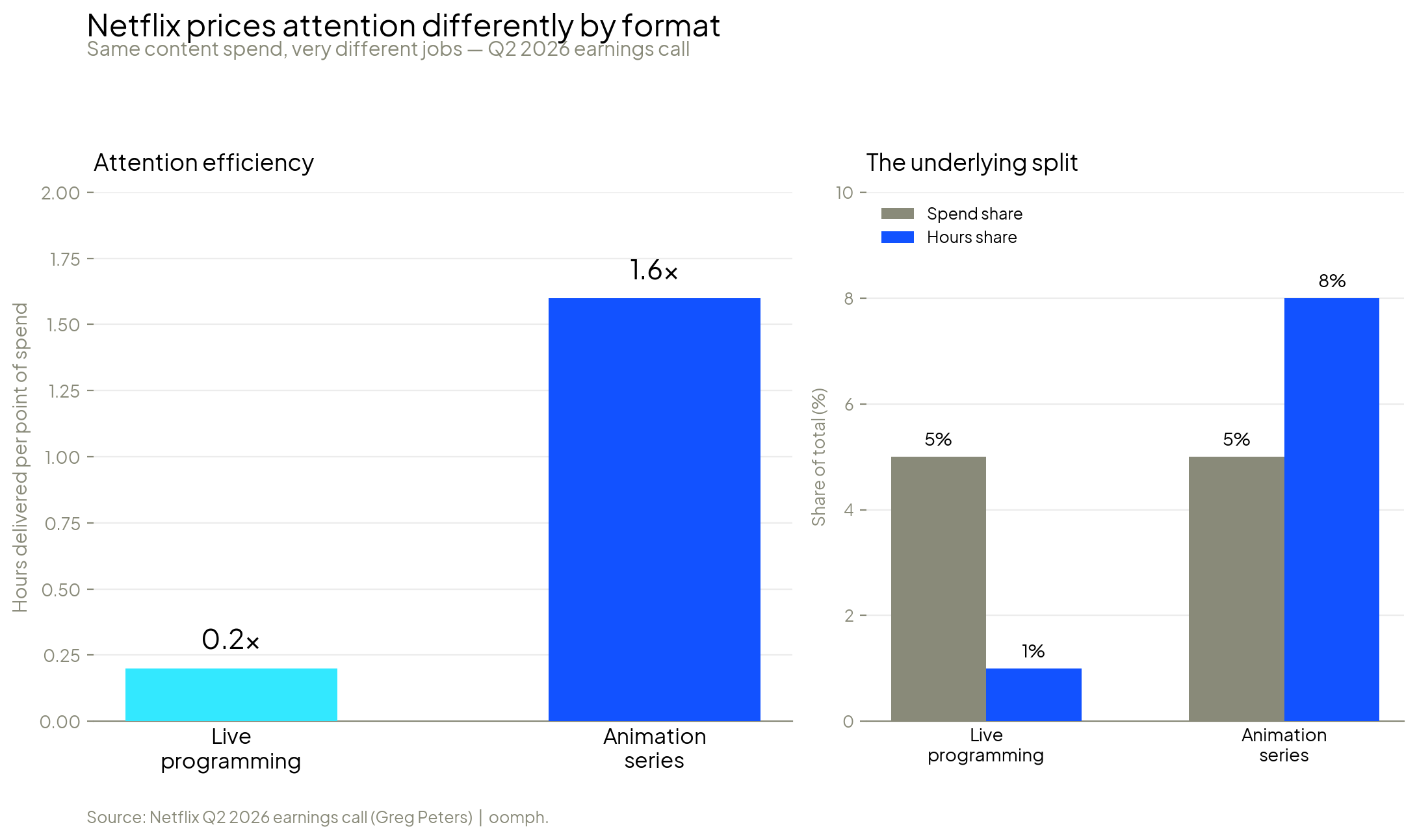
We’ve become so used to thinking of Netflix as TV (although not regulated by Ofcom as traditional UK broadcasters are). But, by failing to bulk up on all that WBD protein, it seems destined to scrap with other platforms for cheap, creator content to build incremental audiences.
This means greater competition against Amazon, which launched its own Creator Hub on Fire TV this summer, pulling in more than 120 creators at launch. Fire TV owners can watch new YouTube uploads from names like Dude Perfect the same day they go live. At Amazon’s May Upfront, the pitch to advertisers was blunt: video podcasts are, in the words of one Amazon ads executive, “the new home for talk formats” – pitched explicitly as competing for TV budgets, not sitting alongside them. Oprah signed a podcast deal with Amazon’s Wondery at the same event.
It also puts Netflix in uncomfortable competition with FAST networks. Peters was even asked directly by an analyst whether Netflix would build a FAST platform itself. He said Netflix would “continue to consider” which is a studied non-answer from a company that spent a decade insisting subscription was the whole model and used to flat-out deny it would feature advertising.
Ads: more pressure to YouTube-ification
But feature advertising it does, since 2022.
And this platformisation of Netflix is entirely predictable for any mature digital service which monetises through advertising. It’s a step beyond the normal windowing strategy we see among broadcaster and native streamers e.g. Sony will license Spiderman movies to Netflix in the UK for a few months, then Amazon Prime Video, and now it’s about to stream exclusively on iPlayer.
By featuring a growing list of podcasts and creator content, Netflix is building a Roku-like proposition, where publishers will have their own long-tail FAST channel. (It’s arguably the path that YouTube could have taken – create a separate Netflix-style fit for TV sub-brand that would be premium and brand safe. But that’s unlikely to happen as long as it’s owned by YouTube, which is all about ever deepening information networks in order to improve its core proposition of search.)
Last night’s earnings call also revealed the same instinct on the advertising side. Netflix used this call to talk about opening up “programmatic access to Pause Ads and live inventory,” language aimed specifically at reducing the friction that has historically kept smaller advertisers out. That’s the same play as the creator strategy, run on the other side of the business: instead of widening the base of who makes content for Netflix, it widens the base of who pays for it.
Two fronts, one instinct: stop being a service only the biggest players (studios on one side, national advertisers on the other) can access, and start being a platform anyone can plug into.
No one at Netflix used the word “platform” on the call. They didn’t have to.
Peters made a version of this argument himself back in January, when he was defending the WBD deal against antitrust concerns. He told the Financial Times Netflix sits below 10% of TV hours “in every market that we serve,” naming Amazon and Apple as the real competitive threat.
Netflix is one competitor among many on a much bigger battlefield than “streaming wars”.
Why watch times and share price are at odds
Here’s where it gets complicated.
Back in January, I wrote about Netflix’s declining watch-time as the reason it needed Warner Bros. Discovery. Netflix’s own Q4 2025 shareholder letter admitted engagement had taken a hit in the back half of 2025 and attributed it, specifically, to a lower volume of content Netflix had licensed from other studios. That admission landed on the same day Netflix moved to an all-cash bid for Warner Bros.
The market reaction was brutal: Netflix shares fell more than 30% in the three months to that January report.
Around the same time, the Wall Street Journal reported data from market research firm Luminate which found Netflix’s share of US original content viewing time fell below 60% in 2025 – a new low.
My analysis of Netflix’s title-by-title viewing data across the last three years shows total hours climbing steadily and without interruption – from 93.46 billion hours in the first half of 2023 to 97.66 billion in the first half of this year. There is no dip in that line, anywhere. Watch time growth on Netflix is actually accelerating: 2% growth in the first half of 2026, against 1.5% for all of 2025.
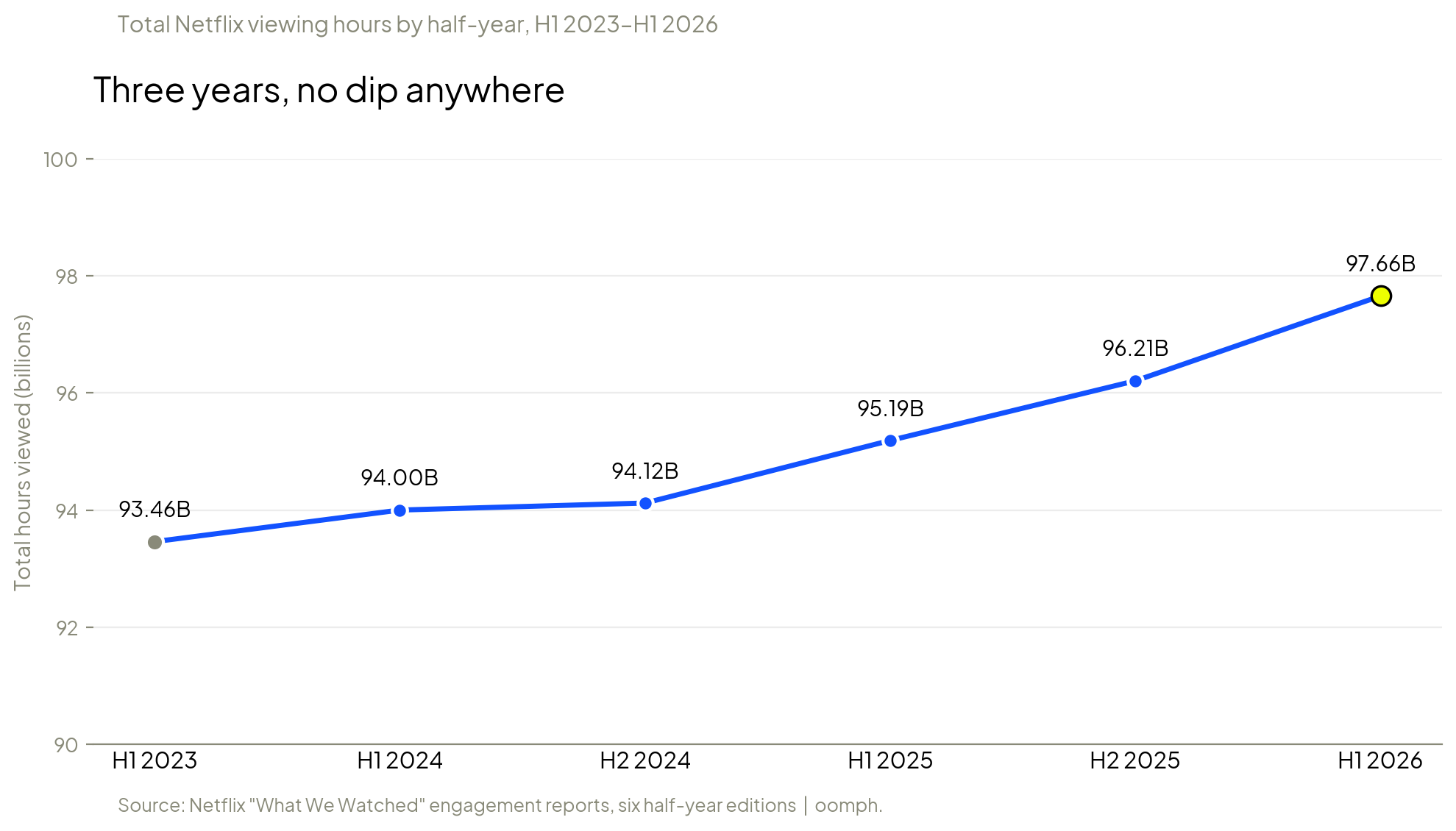
So the actual picture seems to be: Netflix’s total viewing keeps climbing, but that share is shrinking relative to Amazon, Disney and YouTube.
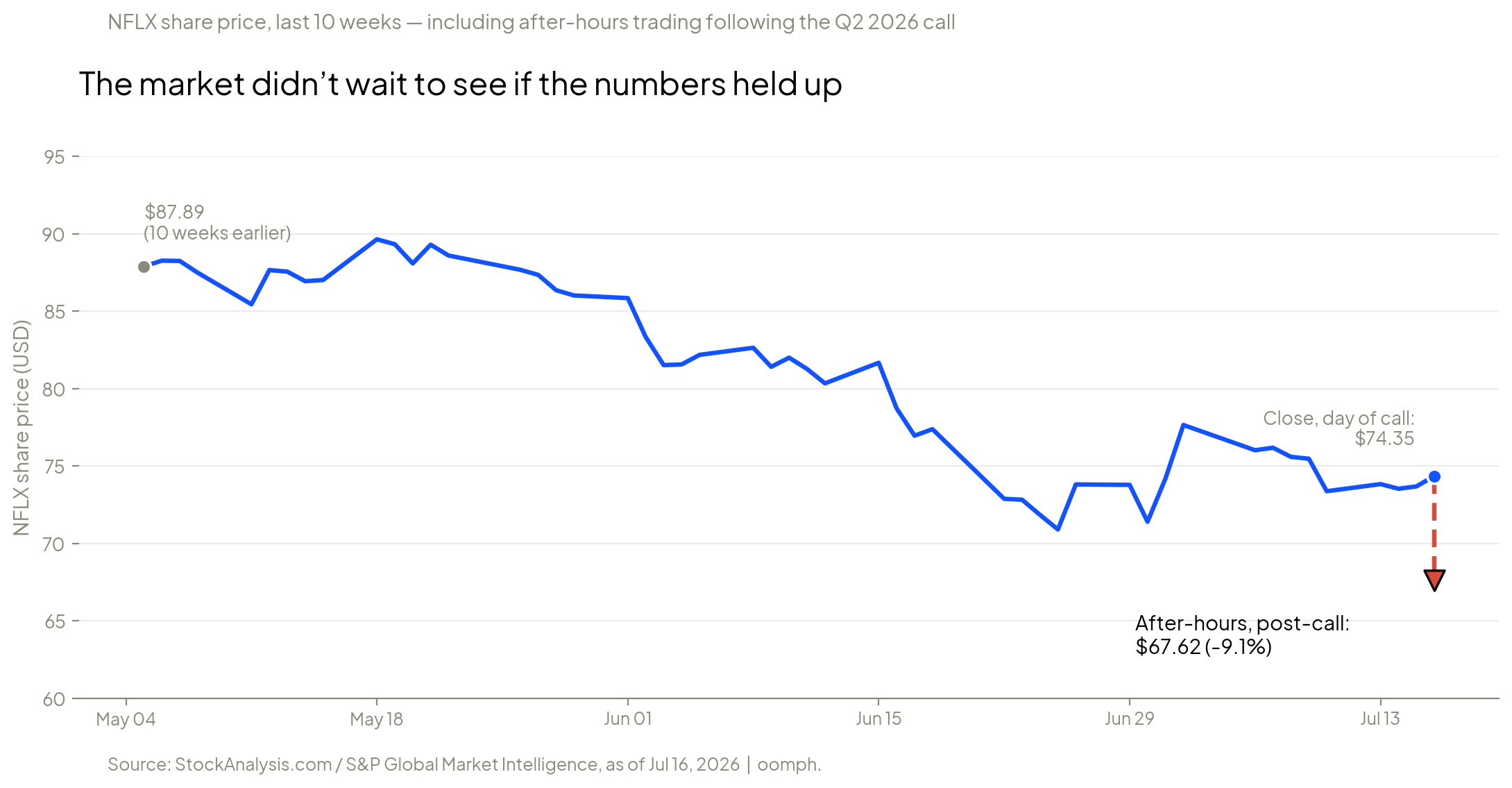
Which would explain why Netflix’s stock has had one of the worst years of any major media company. It closed at $74.35 the day before this earnings call, near a 52-week low of $70.86, and down almost 20% for the year heading into the report, off a 52-week high of $127.75. Bernstein, the equity research house, cut its price target by 9% just over a week before the call.
And, after last night’s earnings call, Netflix shares fell by another 9% in after-hours trading.
What they won’t tell you
Buried well below the fold of most earnings-day coverage: Netflix said generative AI workflows have now touched roughly three hundred titles this year. A year ago, in July 2025, Netflix had confirmed GenAI use in exactly one production – the Argentine series El Eternauta. One title to roughly 300 in 12 months is the kind of number that should be leading business coverage of this call, not trailing it as a footnote to the margin conversation.
Which brings us to the line in this letter that deserves the most scrutiny and got the least of it.
Netflix’s own framework for judging its business now rests on three words: quality, variety, quantity. Asked directly to explain how “quality” is measured, co-CEO Greg Peters declined, on the record, to detail it; arguing the metric took years to build and represents a genuine competitive advantage.
Maybe that’s true. It’s also, conveniently, unfalsifiable: how are investors and journalists supposed to measure this mystical sense of quality?
Netflix also announced it is retiring its What We Watched engagement report from the earnings cadence altogether, moving it to a standalone annual release starting next year.
So, going forward, we’re getting less quantitative data from Netflix. That rather seems YouTube-ish, too!
 This article first appeared in Ad-verse Reactions, a newsletter written by independent journalist and consultant Omar Oakes, covering the economics, power structures and unintended consequences shaping advertising and media. You can subscribe to Ad-verse Reactions for regular analysis at omaroakes.substack.com.