Omar Oakes: Can ethical social media survive the Attention Economy?

Interview: Dominic O’Meara has built a social network that rewards charities and kindness. But has it come too late for Supernova?
Not so long ago, the idea of avoiding social media was unthinkable for anyone with ambitions to succeed in media or advertising.
Having gone through the initial early-adopter phase of Facebook 20 years ago, as it transitioned from a student flirting network to the world’s chatroom, our imaginations were captured by proximity to influential figures (Twitter), an enormous video library (YouTube), and the curation of highly engaged communities (Reddit).
Not only did the internet seem a more interesting place by the end of the 2000s, it seemed that we were entering a new normal of publishing. Advertisers and media owners were competing for social media managers to create all this content and maybe even have a strategy around it. New kinds of agencies, branding themselves as “social media agencies” or “digital agencies”, became the hot young things attracting fresh investor money.
Having secured my first job as a reporter in 2009, the newsroom advice was simple: get an iPhone, sign up to Twitter, and Tweet Tweet Tweet! Don’t miss your opportunity to be part of this network which is only going to get bigger and more interesting over time!!
Well, it’s 17 years later and a good few years since I left X (Elon Musk’s atrocious name for Twitter). I can’t even remember when I left Facebook. I tried Instagram briefly and didn’t see the point. And LinkedIn, well, seems fundamentally broken given that I never seem to see posts from the people I regularly interact with, nor do my posts seem to get the same reach as they used to.
And what impact has breaking free from social had on my career? Almost certainly a net positive. For every random DM I would get from a potential hirer, or Radio Five Live producer asking me to appear on air, or nugget of insight from a clever Tweet, I have had, for several years now, the benefit of not playing the game.
It’s taken a while, but I’m convinced that the benefits far outweigh the lost opportunities. For starters, always-on social media activity is a massive drain of time and energy. Whatever the benefits are of having a fresh and lively online profile, they feel dwarfed by the obvious cost of being unpaid labour in this grand effort to make Silicon Valley tech bros even wealthier.
More importantly, I no longer have this sense of anxiety that I’m missing out on being part of this so-called online hive mind. Or that culture is rapidly passing me by because I’ve not got up-to-the-minute info about when Andy Burnham will become UK prime minister, or that people are going to forget I exist because I’m not ‘part of the conversation’.
At the risk of bragging to make to a serious point, I’ve never been happier or more productive. I spend hours thinking about what to write in the service of creating something deeply impactful and meaningful to my audience. Compare that to the vast majority of Twitterati, who spend literally hours on instantly-understood punchlines to gain likes. This isn’t conversation; it’s a never-ending armchair version of Have I Got News For You?, except with no moderator and thousands of comments straining to be heard.
Being happy and productive doesn’t just give me more pleasure as a thinker and a writer, it affirms my credibility as strategist and content creator for my clients. Because writing is thinking. So the longer we spend on writing, the better thinkers we will be. (And I promise not to reheat the ‘don’t use AI to write for you’ sermon, which you can find here…)
‘Such a waste of time’
I hope my interviewee Dominic O’Meara will forgive that indulgent preamble, especially because it suggests what follows will be a hit job, given that he has launched this new(ish) social media app called Supernova.
I promise, this is not a teardown. I wanted to interview Dominic because a) the app looks genuinely interesting, b) he has very strong views about the state of online media, c) I deliberately wanted to challenge my personal view that social media, broadly, has become a waste of time. Not to mention the myriad harms caused by social, which is set to be banned in the UK for under-16s.
Supernova presents itself as a new social network that is “designed differently from the ground up”. Sir John Hegarty, arguably UK advertising’s most famous living creative director, has invested in the startup and serves as its creative advisor. Other big-name industry backers include Anomaly founder Carl Johnson, 180 Amsterdam founder Guy Hayward, and ex-IPG Mediabrands UK CEO Richard Morris.
So imagine my surprise, when I opened our conversation by asking what motivated this venture, he began by looking at the early platforms in 2008 and 2009 and concluding: “it just looked like such a waste of time, such a lot of rubbish.”
But that was the era of peak social-media evangelism, wasn’t it? Fast forward to today, and his assessment isn’t much brighter: “The rest of it is unnecessary, overloaded, bewildering, often quite freaky, can be quite disturbing, like the endless barrage of stuff like you get on TikTok, which I think is brain death from the second you open it.”
Freaky? Disturbing? Brain death? So why in the world would you aim to compete in this sort of market?
Because, he insists, Supernova can offer a better alternative. As if the world needed to see social media at its worst before being ready to accept a version of its best.
O’Meara’s advertising career began in 1985, as one of 10 graduate trainees at Saatchi & Saatchi, and would become what advertising creatives call an account handler and director at agencies GGT, DMB&B, Doner, TBWA and Naked. And yet it’s the Saatchi bosses he worked for four decades ago who would become his backers today: in October 2022, David Kershaw, Bill Muirhead and Jeremy Sinclair – the trio who ran the breakaway M&C Saatchi until a 2019 accounting scandal – put £2m into Supernova at a £10m valuation.
Nor is this O’Meara’s first attempt at fixing social media. Between 2016 and 2020 he ran Baagloo, a VC-backed social app that claimed over 15 million monthly impressions before it quietly closed. Supernova, which he founded in January 2021, is the second time he’s tried.
O’Meara has now landed on the conviction that social media per se is not the problem, but the way that Big Social have designed their apps is. Not a category error, but a lack of alternatives to doomscrolling and ragebaiting.
Supernova mirrors a clean, image-and-video-led layout similar to Instagram, but it contains no algorithm built to keep people scrolling. It will be unaffected by the UK’s proposed social media ban for under-16s because it doesn’t let them there in the first place. And, to promote civility and altruism in online discourse, each like a user gives generates a cash charitable donation to causes chosen by the user.
O’Meara’s eyes light up during a demonstration, which shows a female user’s donation history to a children’s welfare charity. “When she looks in the mirror, she doesn’t see the self-satisfied, narcissistic glow of having got a few more likes. She sees somebody that’s altruistically given to the world and that makes her feel good.”
“We’re tapping into a behavioural science, a human nature, which is a positively known thing… it’s why [users] feel disinclined to be antagonistic on Supernova.”
This happens through “likes” being rethought of as democratic votes: users select their preferred cause areas (e.g. mental health or climate change) on their profiles. When a user ‘likes’ a post, that action acts as a vote directing a portion of the Action Fund toward their chosen cause. A “Supernova” (or a super-’like’) multiplies that voting power tenfold.
To combat the “scrolling through bile” effect, O’Meara employs strict hybrid moderation (AI combined with trained human moderators) to actively weed out hate speech, racism, and divisive, hyper-partisan political bickering.
Users must have followers in order to have their content seen on their feed. There is an ‘explore’ section, in the style of X, but that section specifically is curated by moderators, not an algorithm – this is the point he makes to distinguish it from Big Social: “If I go here onto the Explore tab, I see what our moderators have suggested I might want to look at. It’s not coming from an algorithm that’s just that’s human beings that have put this up.”
There are “12-15” of these human moderators, which he says, surprisingly is more than is enough at present: “We get barely any negative content, we get barely any rude or unpleasant stuff for antagonistic content that needs to be removed, but we do have moderators primed and able to remove it where it is necessary.”
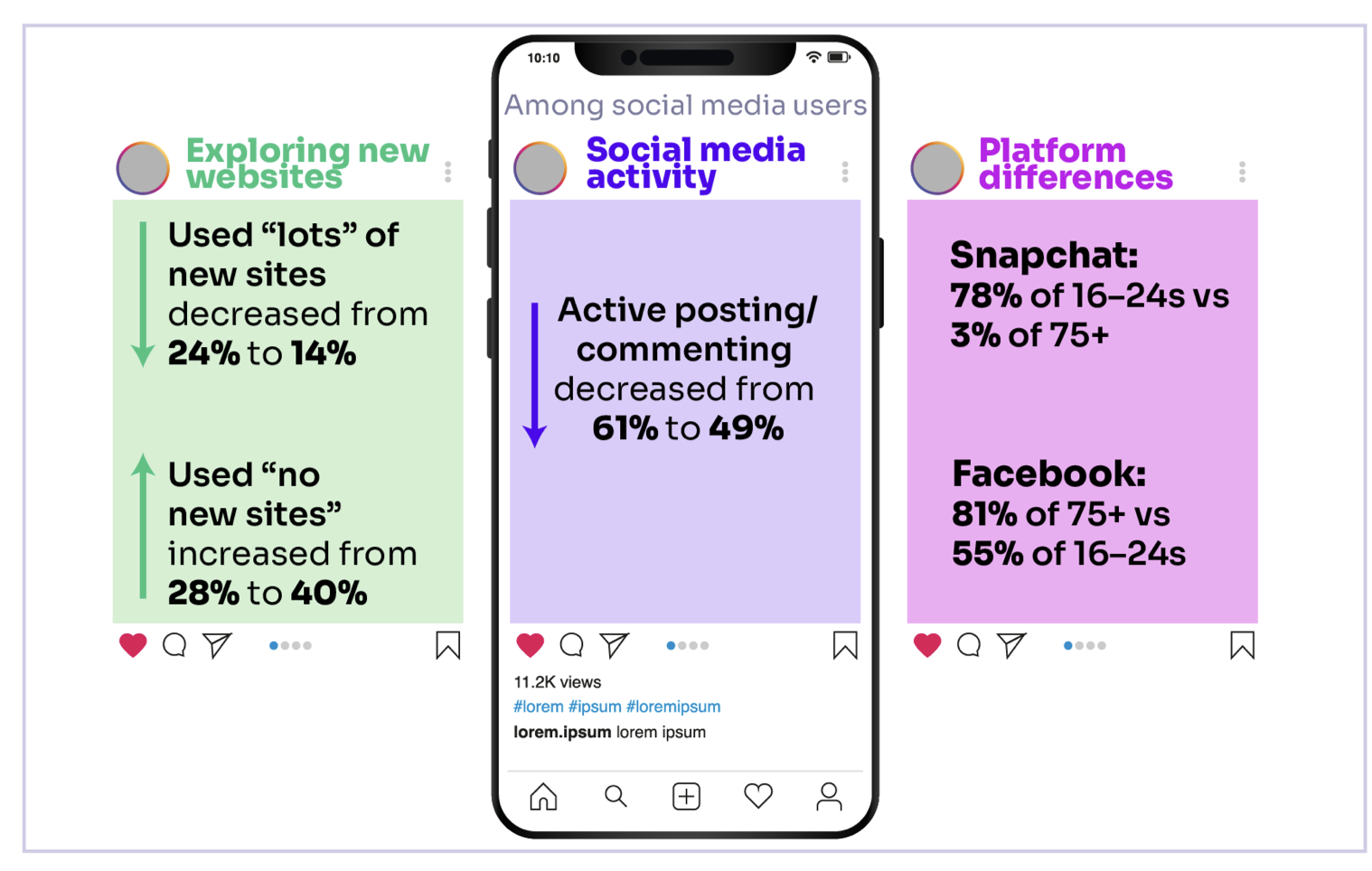
It certainly feels like interesting timing for a contrarian design. And yet Ofcom’s most recent Adults Media Use and Attitudes report shows active participation in social media (posting, commenting, sharing) has dropped from 61% in 2024 to 49% in 2026. Suddenly my recent LinkedIn experience doesn’t feel like such an isolated case: less than half of people are doing anything on social other than scrolling, having a look, then going away. While Big Social (Meta and YouTube) have clearly modified their platforms to be more entertainment-led in response to the rapid success of TikTok in recent years, it does feel like social is becoming less social.
Meanwhile the same Ofcom report reveals people’s belief that being online does more good than harm has fallen from 72% to 59% over the same period. The share who think platforms are good for their mental health has dropped from 42% to 36%, with roughly a third of adults now saying they’ve deleted an app because of overuse or its effect on their mental health, up from about a quarter the year before.
By contrast, O’Meara reports that the contribution rate among Supernova users is “way, way higher than is typical for a social network”.
He explains: “Most social networks say about 2-3% of their users contribute, that is to say, they post or they put up content that others can enjoy. On ours, it’s between 12-15%.”
It’s a striking figure, until you look at what “high” contribution actually looked like the last time a platform was this young. In 2011, one of Twitter’s early investors, Fred Wilson, disclosed that of the platform’s 400 million monthly active users, 100 million logged in regularly and 60 million tweeted. That’s a contribution rate of 15%, at a comparable stage of growth to where Supernova sits now with its 25,000 users. Twitter’s own numbers, in other words, weren’t far off Supernova’s 12-15%.
No politics allowed
Positivity, it turns out, comes with a rulebook. Ask O’Meara what he won’t allow on Supernova and the answer arrives without hesitation: “We don’t allow any politics.”
Not moderated politics. Not politics-lite. None.
“There isn’t a single political party that’s worth arguing about, because they’re all crap, so we don’t want to help any of them,” he tells me; his reasoning being that no party deserves defending, so none gets a platform.
It’s a tidy solution to the ugliest problem in online moderation: remove the entire category that causes the fights, and you never have to adjudicate who’s right. News organisations are welcome on Supernova, he says, just not for anything political – which for most newsrooms is a bit like inviting a chef into your restaurant and telling them they can’t use salt.
His theory for why news skews negative in the first place is blunt: “we do tend to reward them for printing very negative stuff.” Human nature, not malice, in his telling. He’s not wrong about the mechanism. He’s just not proposing to fix it, only to exclude it.
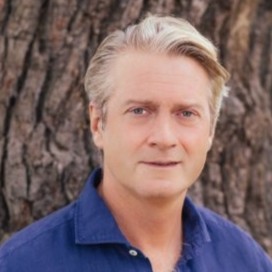
Under-16s get the same treatment, and here O’Meara (pictured, above) sounds genuinely proud rather than defensive: “We policed ourselves, we introduced ‘no under 16s’ from day one…. We just decided we would do it from the moment we drew breath, because we just didn’t think anybody under 16 should be on social media.”
His reasoning stretches past app design into a broader theory of adolescence: “they shouldn’t be on screens at all. They should be doing something bleeding useful, not arguing with each other. Or, if they are going to argue, do it face to face!”
Indeed that argument has been building for some time and feels reminiscent of the 20th Century shift in attitudes towards smoking. In May, the Academy of Medical Royal Colleges told the UK government that most of what eventually brought tobacco under control – taxation, advertising limits, health warnings – barely exists yet for social media. Vivek Murthy, during his time as US Surgeon General under Joe Biden, spent his final months in the job pushing Congress toward warning labels on social platforms, the same treatment cigarette packets have carried for decades.
A few years ago that comparison would have sounded like a joke aimed at someone who’d never opened Instagram. Now it’s fast becoming conventional wisdom; giving a growing number of countries’ lawmakers a justification for ‘taking on’ platforms with bans and threats of bans.
Which raises the question I can’t shake: if the whole category is heading toward the tobacco treatment, does it much matter whether the product inside the packet is the “ethical” one? Nobody asks whether a cigarette was rolled with good intentions.
Don’t be such greedy bastards
So Supernova bans the arguments, excludes the under-16s, and runs without an algorithm. What’s actually holding the rest of the promise together?
I ask O’Meara directly whether the platform’s central pledge – that it won’t slide, the way Meta did, toward maximising engagement over wellbeing – is written into anything beyond his own conviction.
His answer: “Well, it’s certainly within our ethos, our manifesto, our credo to the world, you know.”
Not the articles of association. Not a binding structure. Ethos.
Charity, however, is a big part of the offer. Unlike traditional networks where ad revenue is fully captured by the company, Supernova channels a significant portion of advertising revenue into an “Action Fund” distributed to global charities.
But when pushed on the underlying problem with the industry he’s trying to fix, and he gets more colourful, and considerably more honest.
“Number one, we think: wouldn’t it be a great idea not to be such greedy bastards?” he asks, rhetorically.
Hard to argue with the diagnosis. It’s just that “don’t be greedy” is a personality trait, not a governance model – and personality traits don’t tend to survive contact with investors expecting the hundred-times return he’s already promised them.
He admits as much himself, almost in passing: “for now, it’s like it’s a very strong part of our ethos, it’s a very strong part of why I started this damn thing in the first place.”
For now, I retort. What’s to stop this earnest operation from becoming “enshittified” with worse user experience, weaker content moderation, and more ad inventory stuffed into it?
O’Meara insists that, by making a small dent into a massive market largely dominated by Meta Platforms, that will be enough to make Supernova a £1bn company by annual revenue.

“If you isolate the big advertisers [and] if we’re talking about Meta specifically, and you might as well, because they are sitting like 80% of social media, then you’re talking about 10% of their business coming from big advertisers, so 10% of Meta’s ad business is around £20bn. That, for a company startup like mine, is quite enough to keep our eye on.
“If we got to a 5% share of that 20 billion, would make us a 1 billion a year company. That’s not a bad place to get to.”
In the meantime, O’Meara is targeting a first milestone of 10 million daily active users. “That’s the first magic number we want to strike,” he says.
That would mean “we’ll be generating £300m annual for the company, and we’ll be giving £45m of that [to good causes] as our current numbers stand.
The ‘feel good’ pitch
That would make Supernova one of the UK media’s biggest sources of charitable donations – a quite ambitious achievement that would eclipse the likes of of Red Nose Day, UK charity Comic Relief’s flagship broadcast event backed by the BBC, which raised £34m last year.
Charitable giving, baked in the model, is part of the pitch that Supernova not just as a nicer app for Gen Z and Millennials, but is a brand-safe haven for advertisers who are deeply fatigued by having their corporate ads display next to toxic content on mainstream platforms.
Showing early industry validity, global sportswear brand Asics signed on as one of Supernova’s first official corporate sponsors, and UK mental health research charity MQ was its launch charity partner.
The “feel-good” pitch is highly appealing in theory, but getting users to actually migrate from apps where their existing friend groups, memories, and creators reside requires overcoming massive consumer inertia. Social networks are only valuable in the long-run because other people are on them.
In the short-run, at least, O’Meara cites Vero, another self-styled “optimised for connection, not addiction” social network, as an example of what’s possible.
“They did 3 million [user signups] in a week once… There’s next to no friction. This introduced image recognition, in which case everybody’s got it. So, it’s the same problem opportunity for everyone… The thing is to have really very good, fast, working tech.”
Which is an important observation, because a lack of “fast, working tech” was the very thing that killed VERO’s momentum. While it’s true VERO experienced explosive growth in 2018 (thanks to widespread frustration with Instagram and a ‘free for life’ promise to its first million users), its backend infrastructure collapsed under the weight of the traffic. Users faced server outages, couldn’t post pictures, and were hit with frequent glitches.
A fascinating litmus test
Here’s where I land, for now, on the question I asked myself at the start. O’Meara insists the appetite for something better than Big Social hasn’t gone anywhere: “There’s so many people that use this time, use social media, that number’s not going down, it’s going away from the existing ones.”
He’s betting that a silent majority of social media users want a digital environment that values community wellbeing over outrage-driven engagement clicks.
A minute later, almost despite himself, he says something closer to the truth: “people are falling out of love with social media, because it’s not really social… what is socialabout it?”
I think he’s half right. People aren’t leaving; Ofcom’s own numbers say as much, as total time online keeps climbing even as the will to participate in it collapses. But that’s precisely the problem for a platform built entirely on participation. Supernova doesn’t need people to keep scrolling. It needs them to post, comment, and actively hand out Supernovas – the exact behaviour that’s disappearing fastest, on every platform Ofcom measured, regardless of how good the cause behind the click.
I’m not the target audience for a platform like this. I write about how the sausage is made; it doesn’t mean I have to eat hot dogs every day. But Supernova is offering something distinct and with a clear vision that will surely appeal to many who haven’t lost that belief that digital media can create meaningful communities and inspire new forms of creative expression, without the minefield of addiction, abuse, and ‘brain death’.
Whether Supernova succeeds is not just a litmus test of whether social media can be more than doomscrolling and ragebait. It may be a final answer to a growing suspicions that the only true ethical alternative to social media was to simply not bother with it at all.
 This article first appeared in Ad-verse Reactions, a newsletter written by independent journalist and consultant Omar Oakes, covering the economics, power structures and unintended consequences shaping advertising and media. You can subscribe to Ad-verse Reactions for regular analysis at omaroakes.substack.com.