
Extraordinary court filings allege WPP retained 76% of Sony’s rebate funds in China. But the real story is what the case reveals about the industry’s inability to verify trust.
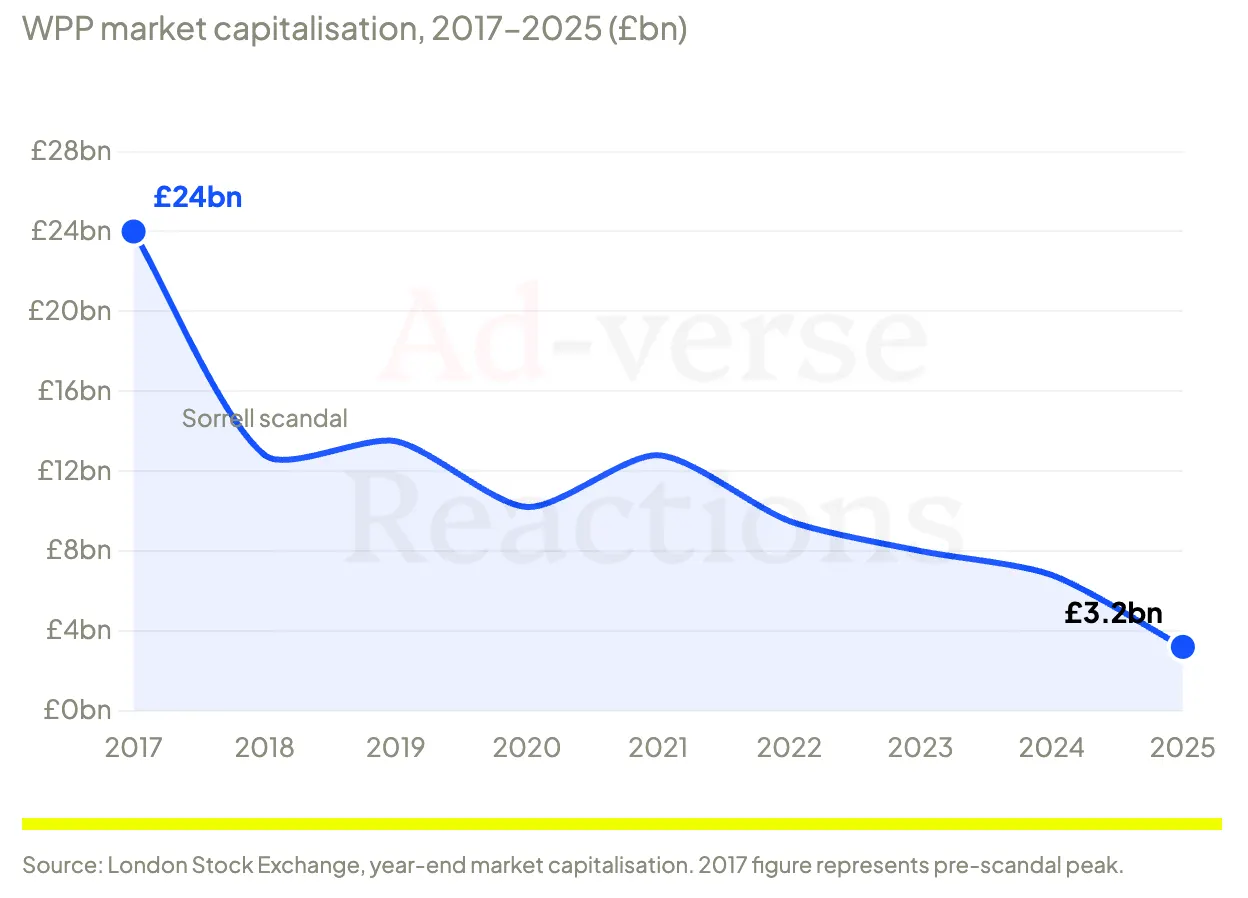
WPP may no longer be a member of the FTSE100 after its market value dropped by 87% (£24bn in 2017 to just £3.1bn at the end of 2025), but there was a major silver lining for the company to promote a few weeks later.
Its advertiser clients were happier! WPP’s most recent Annual Report – published in February under newish CEO Cindy Rose – records a client satisfaction score of 8.2 out of 10; a record high. Clients, WPP reported, view the company positively for “building strong client relationships, fuelling growth and mitigating risk.”
At the same time, WPP chose to redefine its foundational purpose around the word ‘trust’.
The same Annual Report features the word 17 times. The Elevate28 strategic plan positions WPP as “the trusted growth partner for the world’s leading brands in the era of AI.” Rose lists “trusted data and technology solutions” as a structural competitive advantage. WPP says trust “is scarce and must be earned daily.”
And yet just three months before in December 2025 – the same month in which WPP’s shrunken market cap made it too small to remain in the UK’s top public companies – one of its biggest clients was far from cheery and certainly not in a trusting mood.
Sony was in Tokyo presenting WPP’s own lawyers with the findings of an unprecedented forensic investigation into how its media budget was being spent. According to an amended complaint filed in New York State Supreme Court last week, Sony alleges WPP retained 76% of rebate funds in China – $350m against $110m passed to clients – routing the money through 47 shell brokers.
So what happens when one of its largest clients decides to put ‘trust’ to the test, and doesn’t like what it finds?
The case against WPP
The complaint in New York was brought by Richard Foster, a former WPP executive who alleges he was fired in July 2025 after raising concerns about what he describes as an improper kickback operation run through WPP’s media investment arm. He is seeking $100m in damages. WPP calls the complaint “baseless and without merit.”
But last week’s amended filing introduced something WPP will find harder to dismiss: an independent investigation by one of its own clients reaching the same conclusions.
Sony’s probe was triggered by a criminal case. In 2023, Chinese authorities detained three GroupM China executives over an illegal kickback scheme valued at ¥1.2 bn (roughly $176m). The former chief investment officer, Di Fei, was sentenced to life in prison in March this year. Two colleagues received 14.5 years and four years respectively.
It’s worth pausing and reflecting just how serious this story is.
WPP’s top media buyer in China is serving a life sentence for bribery.
(Di Fei is appealing against the life sentence, with a decision expected later this year or in early 2027, according to Bloomberg.)
Sony watched that case, then looked at its own money. What it alleges it found was a system built on murkiness: WPP negotiated rebates directly with vendors, routed the funds through a network of brokers with no operations of their own, retained the majority, and used the hidden pool to fund discounts that looked good on a client’s spreadsheet. WPP’s representatives, when confronted with the findings in Tokyo, reportedly said they did not want to “know the answer.”
WPP has not addressed the specific allegations. And throughout all of this – the criminal convictions, the Sony investigation, the Foster complaint – WPP’s public story has never changed. In February 2026, Cindy Rose told investors the company was “firmly on track” with its transformation plan and “successfully transitioning from a complex holding company to a single, integrated company.” The word “trusted” appeared across every major investor document.
But the allegations describe a company that allegedly retained three quarters of a client’s rebate funds through shell companies. Are those the actions of a company that seeks to earn trust on a daily basis?
This shouldn’t just be about WPP
Over the years, whenever I’ve asked agency leaders about “principal media trading”, where an agency buys inventory at one price and sells it at a margin, they insist it’s a legitimate and common practice. All the major holdcos do this, in some form.
Done transparently, with disclosed margins, it can work for everyone. The media agency group is effectively doing what Tesco does: buys a load of milk from a supplier at one price and sells it to a customer at a higher price. Maybe if you buy more milk you’re entitled to a discount.
And, as the World Federation of Advertisers noted in Adweek’s coverage last week: there are valid reasons for using media brokers in China. The market operates through tripartite agreements, volume-based rebates, and confidential framework deals that have no real equivalent in Western markets. The infrastructure that rewards transparency in London or New York simply doesn’t exist in Shanghai.
If you’re WPP or any of its holdco rivals, you could reasonably argue you deserve (or even need!) a big, fat margin for navigating such complexity. And shareholders, who have already punished WPP with an 87% drop in market value, will not tolerate that margin shrinking.
That defence makes sense… until we remember the 76%.
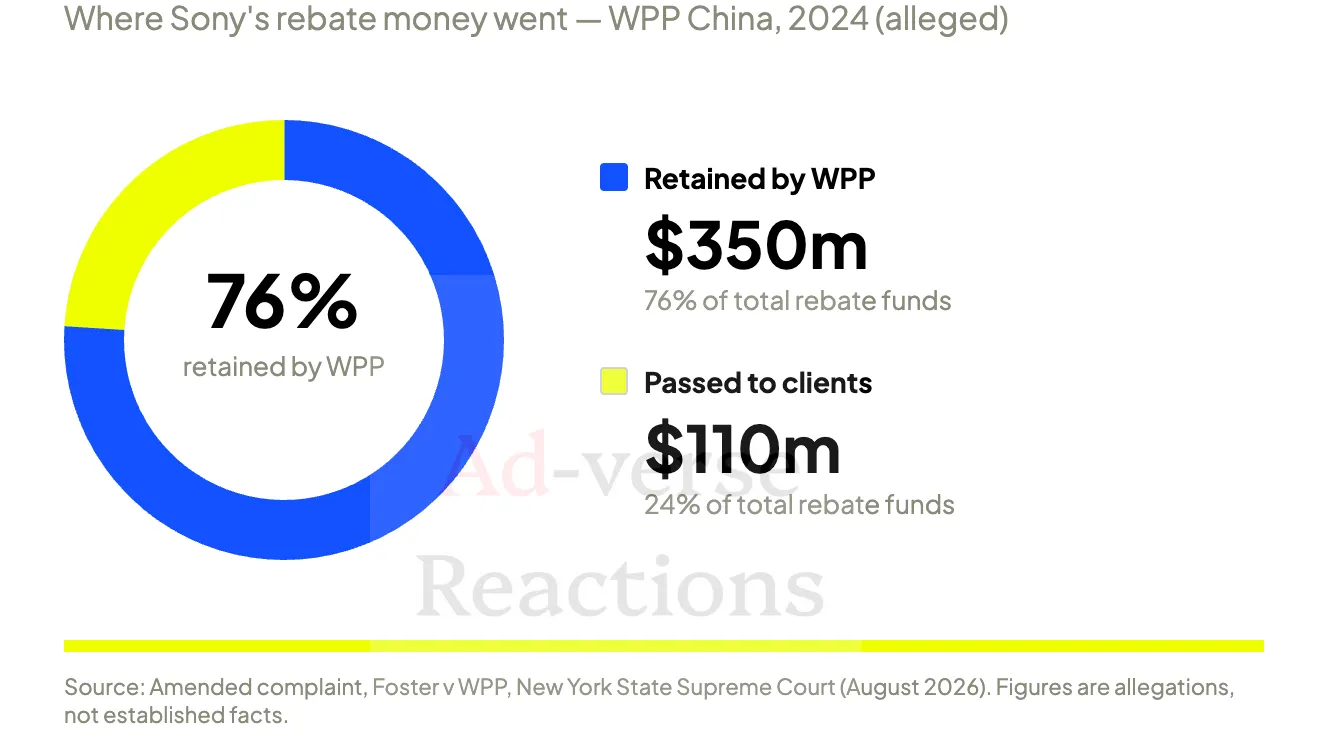
If WPP were retaining 10-15% through principal trading in a genuinely opaque market, this would be a governance conversation about disclosure, not a fraud allegation. But the Sony investigation alleges $350m retained against $110 million passed to clients, routed through 47 entities with no operations of their own. There is a difference between the margin required to navigate market complexity and the margin that exploits it.
The question is: who gets to decide where that line falls: the agency, or the client?
The WPP case exposes something that should trouble any advertiser with a significant agency relationship, regardless of which holding company name is on the contract. It reveals that the mechanisms the industry relies on to verify trust do not work.
Because if there was something dodgy happening with Sony’s budget, why didn’t the auditors catch it? Media auditing, as typically scoped, examines pricing benchmarks and delivery metrics; not rebate flows through offshore broker networks. Sony didn’t find what it found through an audit; it found it through a forensic investigation triggered by criminal convictions.
How many advertisers have the resources and the conviction to do that?
What to ask
If you’re an advertiser spending significant budget through any major agency group, the WPP case doesn’t mean you should be on high alert that your agency is defrauding you. But it does mean the question “how would I know?” deserves a better answer than “we trust them.”
I’m not an auditor (nor would I want to be!), but I’d have thought these questions would be some starting points:
- Can your agency show you the full rebate chain, from vendor payment to final disposition of funds?
- What is the disclosed margin on any principal or proprietary trading conducted on your behalf?
- Does your contract grant you the right to commission an independent audit of rebate flows; not just pricing and delivery?
- Have your media funds passed through any intermediary entities not disclosed in your agreement? And when did you last ask?
- Does your agency distinguish between the margin it earns for navigating market complexity and the margin it retains from undisclosed rebate flows? Can it show you the difference?
Don’t trust the front door. Trust the plumbing
In my latest Media Leader column, I made the case that trust should carry a commercial premium. In a media industry which seems to have lost interest and/or competence in self-regulation – as more money and ads are shown on platforms which can’t or won’t root out fraud and slop – putting your ads in a trusted space should be more valuable than ever.
WPP knows this. That’s why the first thing the CEO did when publishing her first Annual Report was to put “trust” front and centre of its investor-facing material. Even if, as we know now, it was privately facing a major challenge to its integrity from a major client.
But trust, as WPP also says, “is scarce and must be earned daily.”
This is the gap that should unsettle anyone in the industry, not just WPP’s clients.
Every mechanism the industry relies on to verify that the word “trust” means something was measuring the front of the house. But no one was looking at the plumbing. It took a client attending a criminal trial and commissioning its own forensic investigation to find out what was underneath.
Sony asked. Most advertisers haven’t. Why not?
 This article first appeared in Ad-verse Reactions, a newsletter written by independent journalist and consultant Omar Oakes, covering the economics, power structures and unintended consequences shaping advertising and media. You can subscribe to Ad-verse Reactions for regular analysis at omaroakes.substack.com.