
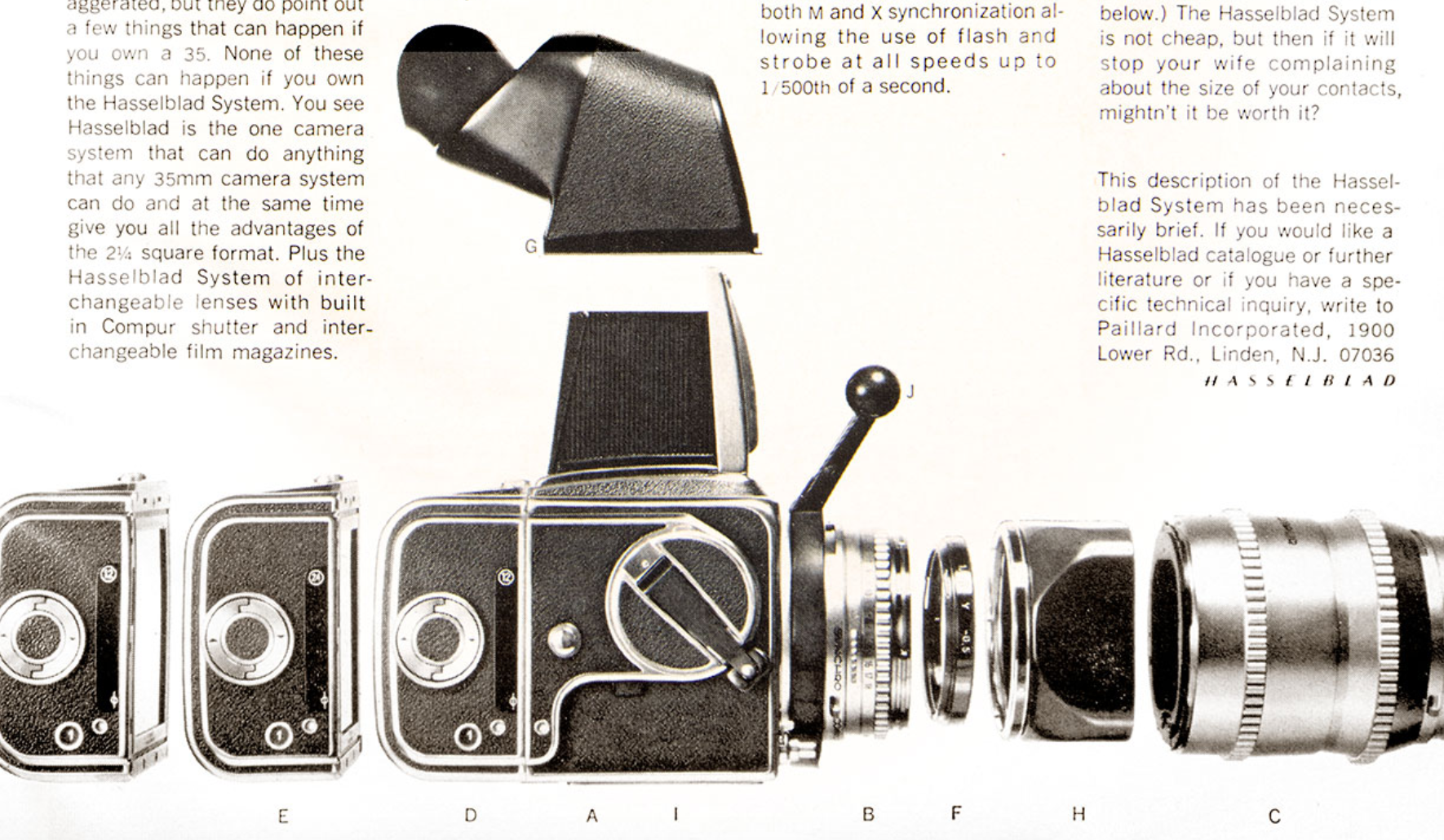
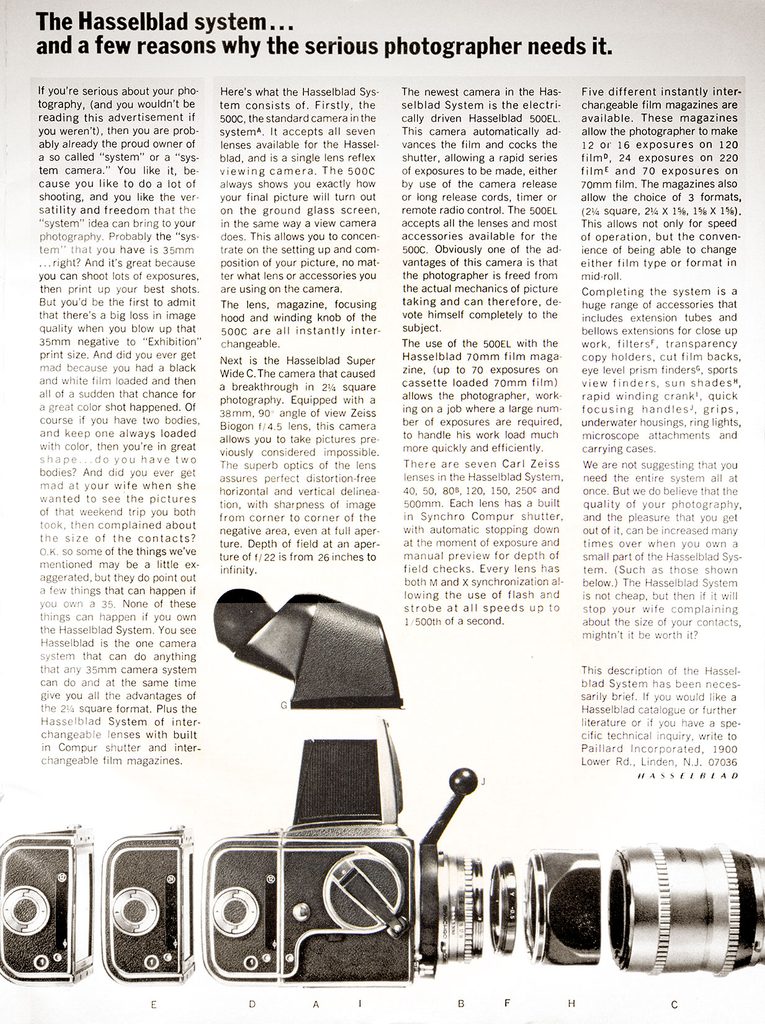
Back in the mid-sixties, before most of you were born, I was the “Copy Chief” (Yes, that job function existed then) at the De Garmo agency in New York. We were one of the hot agencies responsible for the creative revolution taking place at the time, producing award winning work for such accounts as the Irish Tourist Board, Great Western wines and the Brody Corporation, which consisted of such famous New York restaurants as The Rainbow Room and Grill, Gallagher’s Steak House and L’etoile. As part of my job I wrote the copy for what became a multiple award winning campaign for Hasselblad cameras. A series of twelve ads covered what I described as “The Hasselblad System.” Each ad was several thousand words long and dealt with a specific branch of photography, from amateur to professional, pointing out how in each case various components of the system could enhance the effectiveness of the final result. Each ad finished with an invitation to “write in” and request a Hasselblad catalog. There was no coupon, no 800 number, and it was long before the Internet. However, the overwhelming response to the offer required the catalog to be re-printed three times! Who needs clicks when you’ve got something worth saying?
The sixties was also when Hasselblad made history by becoming the first camera in space. It all began in 1962 when Astronaut Walter “Wally” Schirra, who was an enthusiastic amateur photographer wanted a good camera for his forthcoming Mercury flight. He went into a Houston camera store and asked the owner what was the best camera he had in stock. It turned out to be a Hasselblad 500C, a Swedish professional camera costing nearly $500, which was a shitload of money at the time. However, the 500C offered something NASA’s existing American cameras didn’t: a 6×6 cm negative, interchangeable high quality lenses and interchangeable film magazines. (All components of my “Hasselblad System” theme. Get it?) Strangely enough, NASA had not regarded photography as a major priority in recording the missions. Schirra had to push to get the camera aboard Mercury-Atlas 8. Later, the Hasselblad was used by NASA during the Apollo program to capture the now famous and iconic high resolution images of the two astronauts walking on the moon. Ironically, the Hasselblad System allowed them to save weight on the return journey to Earth by keeping the film magazines and leaving the bodies and lenses on the surface of the moon!
Does this now mean that Sweden owns the Moon… Better not tell Trump!!!