No operating model is best, says a new WFA report co-written by a consultancy that sells operating-model advice. Does Unilever, which still buys from everyone, prove its point?
If you haven’t read up on Unilever’s investor event, held earlier this month, you should. Some of the numbers are remarkable, such as 500,000 creators now work with Unilever, up from about 20,000 two years ago. Or chief marketing officer Leandro Barreto’s claim that Unilever is “producing 12 times more content than in 2024 at a 90% lower cost”. What exactly is this content and what kind of quality are we willing to put up with to achieve this kind of cheaper volume? But the most striking thing was the explanation. Fernando Fernandez, Unilever’s CEO, said Unilever’s return on media is rising 10-15% a year but doesn’t think these gains will be reflected in the company’s bottom line. They are rather, in his words, “a fundamental insurance to play”. Excuse me? One of the world’s biggest advertisers has admitted its scale no longer buys an advantage. Should we read its efficiency gains as a premium paid to Meta, Google, Amazon, Walmart and TikTok just to stay in the game? I think so.
Unilever buys from everyone
Unilever has been building in-house since 2016, when it launched U-Studio with Oliver (now part of Brandtech Group). Barreto now says: “We brought together media planning and media buying, and we keep the data.” But, of course, it still buys from agencies. Its 2024 global media review kept WPP’s Mindshare in the US, UK and China, and added Publicis Groupe and Dentsu. This year, seven agencies pitched for its foods influencer work, and specialist agency SAMY won. And it still uses referees, the consultancies who run and influence the agency pitch process. PwC’s media practice, now part of Mediasense, supported that 2024 review, Campaign reported. The same Mediasense has just co-authored a report with the World Federation of Advertisers, Which Media Operating Model Are You? It surveyed 72 global advertisers and sorted 67 of them into four archetypes: 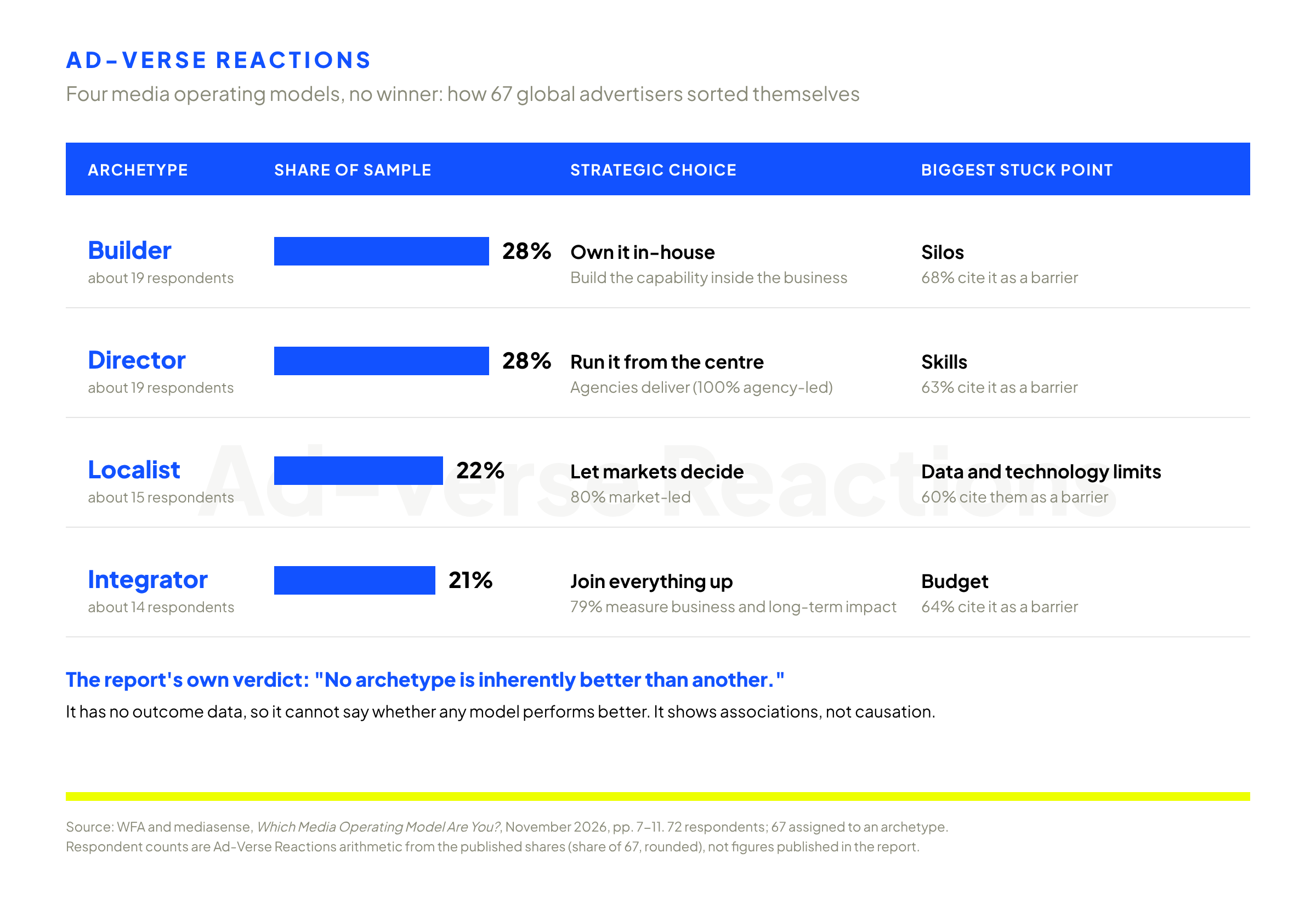 Its central finding: “No archetype is inherently better than another.” Does Unilever prove the point? It’s centre-led on brands, market-led on media and in-house on data. So it doesn’t fit just one box. The report has no outcome data, so it can’t say whether any model performs better. Each archetype rests on roughly 14-19 respondents, and its most quotable line moves the problem neatly: “A new agency won’t fix an operating model problem.” Is the translation, then, that your problem isn’t your agency but your organisation? And organisations need advice… which is quite convenient for a consultancy selling advice! But that doesn’t make their reading wrong.
The referees want to play
Convenient because Sam Tomlinson, Mediasense’s chief executive, told Digiday in July he wants the firm to be “the No. 1 advisor of choice for marketers and their colleagues”. Tomlinson had been PwC’s UK media lead for 15 years and established the separate consultancy division in 2017. Agencies and big tech, he argued, offer advice that’s expert but not independent. The commercial logic behind this thinking is clear: a pitch is a one-off fee every three years, but transformation is bigger, longer and repeatable. Or take Ebiquity, which appointed a Global Managing Director of Marketing Transformation, David Muldoon, in February. We’ve seen referees turn into players before. Accenture shut its media auditing business in 2020, after critics argued it couldn’t audit agencies while competing with them. The difference now is that the intermediaries aren’t buying media. They’re bidding for the advice. Is that conflict harder to name? One thing’s for sure: demand is real. In the 2025 edition of the same WFA study, only one in three advertisers said they had the right media organisation. Someone has to fix that.
The agencies, bidding as vendors
So why aren’t agencies winning it? They sound like they want to… up to a point. In my Media Leader column last week, I reported from Future of Media London where Dan Clays, Omnicom Media EMEA chief executive, declared: “We’re now in the business of integration.” But Michael Karg, WPP Media Europe chief executive, let slip: “The vast majority of the number of pitches is still media [pitches].” My basic point was that the big agency groups – the sort of business Unilever still trusts with its core media accounts – talk the talk of being strategic partners but ultimately get paid for delivery. Instead of truly aspiring to be consultants (independent or not), they carry on doing the work of vendors for advertisers. Very large vendors, but nonetheless stuck in the lower category of ‘order taker’ rather than ‘trusted advisor’. The data in this new WFA report hints at the cost. So-called ‘Directors’ hand 100% of delivery to agencies, yet just under two-thirds (63%) say they lack the skills to direct them. Agencies do the work, but are clients getting the judgement? One senior agency group executive told me privately a few weeks ago that transformation only lands when it’s routed through media: “Ultimately, you’ve got to work with media.” They may be right, but it’s the mirror image of Mediasense’s claim: each side says the cure sits in its own territory. The agency holdco exception is Publicis which, as Nick Manning sharply observed in September, is “no longer an agency group”. Its deals, he writes, are set at a much higher level than a client/agency relationship, negotiated at the most senior levels and embedded in business processes. His prediction for the referees is the key passage:
This will have a major effect on the pitch management community, specialist lawyers and auditors, and independent media consultancies, shifting their role toward organisational and operational support with higher technological and analytical capability. Independent auditing of data and its use will eventually replace cost benchmarking.
The “major effect on the pitch management community” is already happening, as discussed above. If the biggest agency group wins work by enterprise deal and not by pitch, the referees’ core business of running pitches is not just a lower-value commodity; it’s under threat – full stop – as a service offering. And Publicis’s tactic may be different, but it’s still a way to win the same game the holdcos have been playing for years. Transformation sold as a platform. So the holdcos are caught in a negative spiral of value: offering more for less through enterprise deals, fewer planners, and therefore less strategic input, which means agencies can’t transform themselves, which leaves them weaker against procurement. Let’s call it The Vendor Spiral: 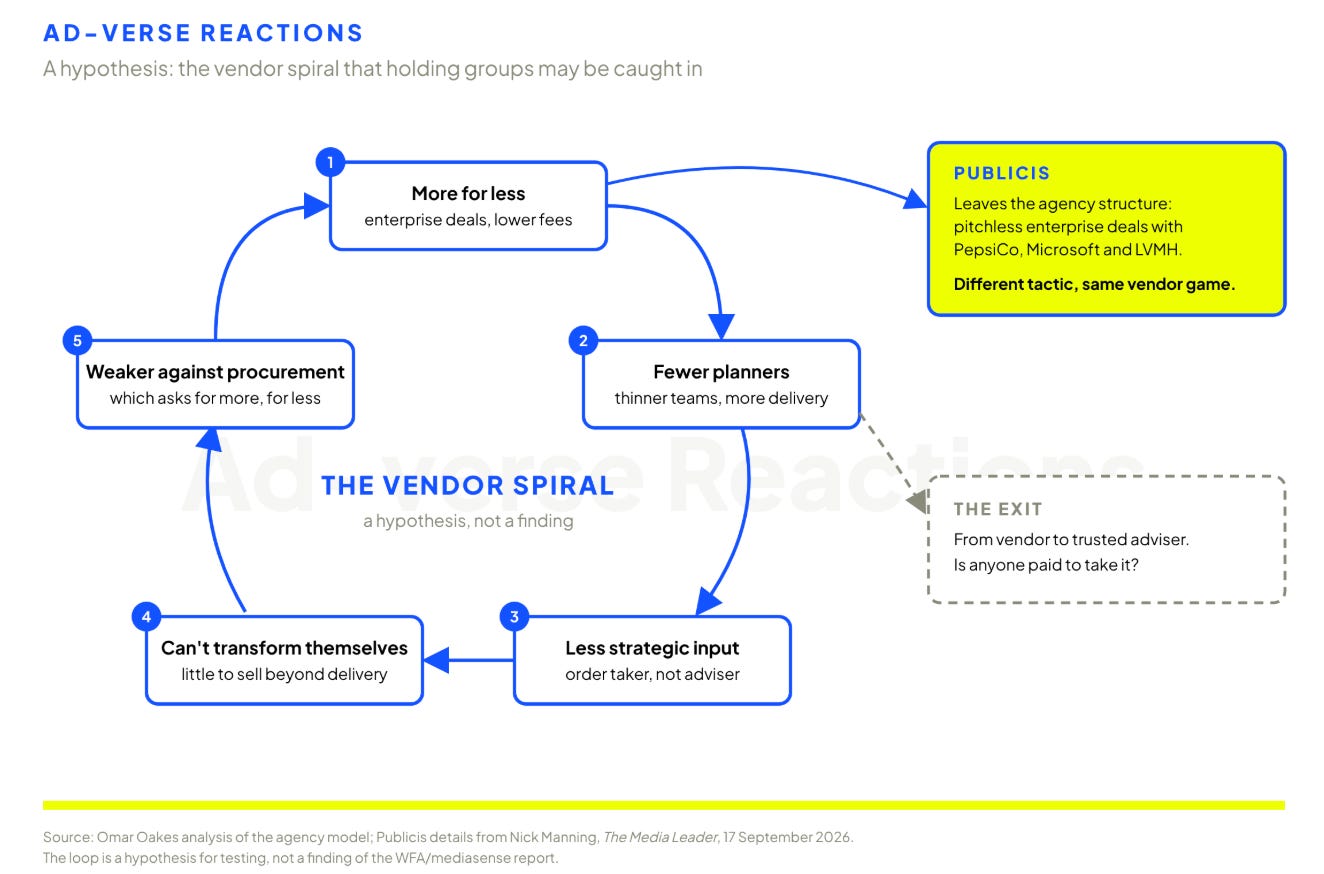 But then only 15% of advertisers in the WFA study name the agency model as a barrier. I suppose that could be construed as good news. Or is it really a sign that clients no longer think of agencies at all when they think about transformation?
The do-it-yourselfers
Then there are the clients doing it themselves. In 2023, 82% of members of the US Association of National Advertisers said they had some form of in-house agency. But Unilever shows what DIY really means: an in-house layer on top of agencies and advisers, not instead of them. Builders, the most in-house archetype in the report, are also the most likely to cite silos (68%), so does ‘owning the machine’ stop it from fragmenting?
Who’s left standing
Each party has a story about the others:
- The referees say the agency isn’t the problem: the client’s organisation is.
- The agencies say consultants’ transformations don’t land.
- The clients bring work in-house to escape both.
Meanwhile, one party stands outside the contest. Fernandez told investors that the media platforms now set the price of attention: “the level of engagement that you provide to the platform fundamentally changes the price you pay.” He said his gains compensate for “a fundamental change in the balance of power between a very concentrated media platform landscape and the industry”. So agencies, intermediaries and advertisers are fighting over who owns transformation. The platforms are the ones sending the invoice. Which raises an uncomfortable question: if the biggest advertiser’s transformation boils down to “insurance”, not advantage, what exactly are brands, agency groups and intermediaries fighting so hard to own?
 This article first appeared in Ad-verse Reactions, a newsletter written by independent journalist and consultant Omar Oakes, covering the economics, power structures and unintended consequences shaping advertising and media. You can subscribe to Ad-verse Reactions for regular analysis at omaroakes.substack.com.