
Interview: Channel 4’s chief commercial officer on YouTube’s cut, winning Paramount’s ad sales, Molly Russell, and why he’s become “comfortable” telling advertisers they’re funding harm.
Does Channel 4 want to beat YouTube, or become more like it?
After its upfront on Thursday 15 October, billed as a “Cheeky Little Gander”, and my interview with chief commercial officer Rak Patel the next day, I’m still not sure.
On stage at BAFTA, Patel told advertisers that comparing platforms with broadcasters is “like saying Waterstones is a book”, and that “YouTube itself is not TV”.
He also struck a sombre tone, saying: “Governments around the world are now restricting or banning children’s access to social media, including here in the UK. Have we reflected on that?”
He went on: “Every pound spent is not just a media decision. It’s a funding decision. Is it really good enough that these platforms have brand safety tools which try to stop negative exposure for a brand, when the platform itself is coming into question because it has such a profound negative impact on society?”
These are the right questions – arguably the questions everyone in this industry should be asking every week, if not every day. It won’t surprise you that how advertisers should think about their media choices was the subject of my Media Leader column this week.
And it’s a sign of the times that this kind of language is now standard issue for a broadcaster’s set-piece sales event. The unspoken etiquette which used to prevent such “calling out” of Big Tech is long gone.
As the interview will show, Patel, a father of four, is unafraid to talk about advertising in such moralistic terms, having been brought to tears by the harrowing documentary Molly vs The Machines. “How can we rest easy as we come to the end of our careers, knowing this was on our watch?” he asks.
Indeed. But hang on. Earlier in the same event, Channel 4 Sales had launched Instant Re4ch, a campaign-launch package that includes a 48-hour takeover across its 30-plus YouTube channels.
When we spoke, Patel was franker about the money. YouTube’s revenue share, he said, “is a lot higher than I have on any other channel, whether it’s owned and operated or even some of the other partner channels”. And: “I would like to make a lot more revenue.”
That isn’t hypocrisy. A broadcaster whose remit includes reaching young audiences can’t walk away from the biggest video platform on earth. But it does complicate his funding-decision argument. Channel 4 takes YouTube’s money too, and wants more of it.
How much YouTube currently brings in, he wouldn’t say, beyond confirming it is not replacing linear revenue “like for like”.
Now, YouTube isn’t all social media. Nor, as Patel repeated during our interview, is it TV. But it has carved out a very advantageous space between the two. Call it media ‘cakeism’: pitching itself as the new TV while declining the entry requirements for the TV club. Patel’s version of those, on stage, was that TV is “professionally produced, independently measured, regulated and human verified”.
But credit where it’s due: you can’t ignore YouTube, and you’d be crazy to try.
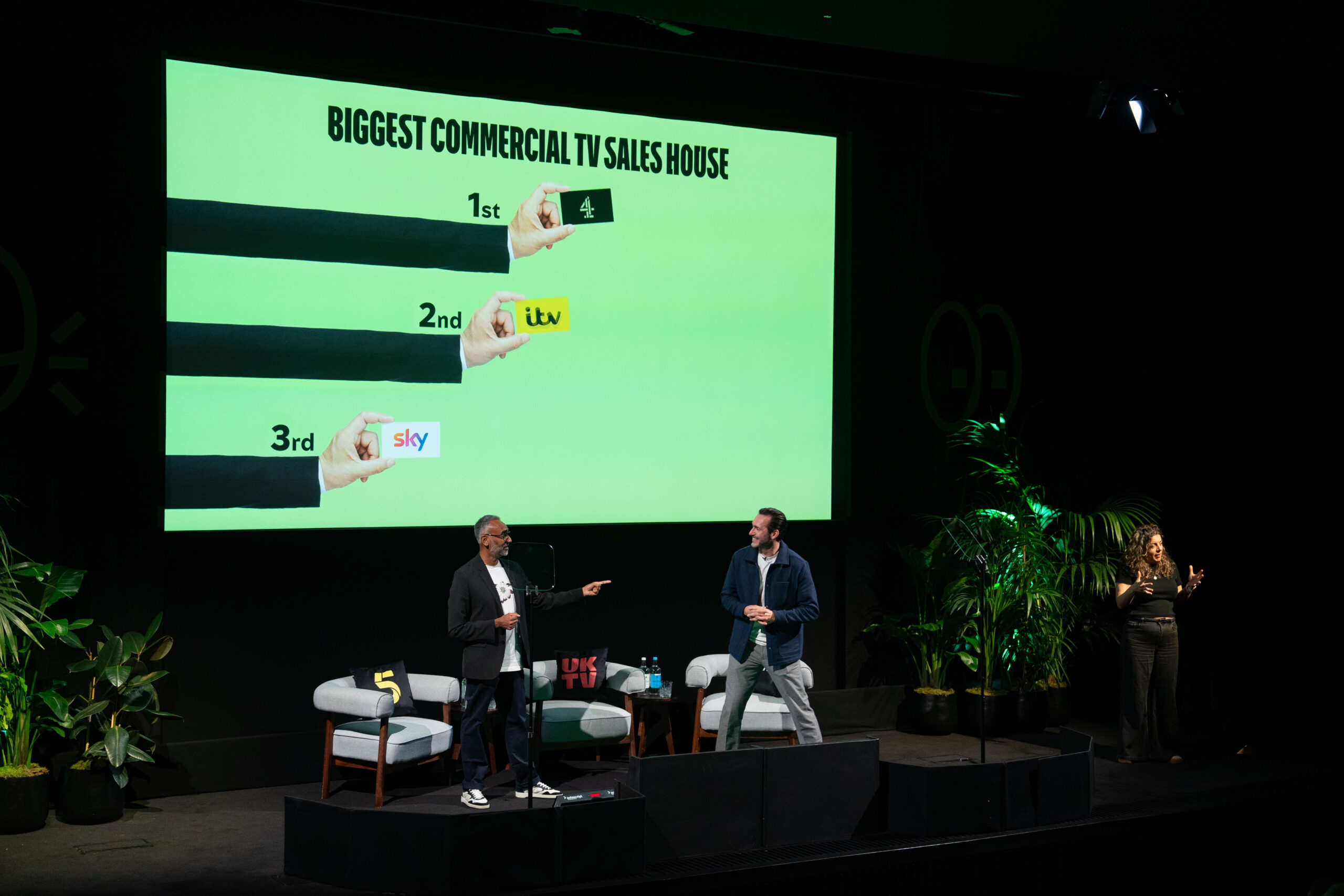
The backdrop is Paramount. From 1 January 2027, Channel 4 Sales becomes the exclusive UK ad sales partner for Paramount’s brands, including 5. That makes it the UK’s biggest TV sales house by reach, as Patel confirms below.
We also covered why Paramount chose Channel 4 over Sky, whether advertisers who keep spending on social are funding harm, Molly vs the Machines, talk of a joint streaming service with the BBC, and whether brands should buy on ethics or results.
The YouTube exchange is under “YouTube’s cut”. A summary of everything Channel 4 announced at the upfront is at the bottom.
I couldn’t attend the event, so I watched the recording afterwards and interviewed Patel the following day. The beow has been edited for length and clarity.
Becoming number one
Omar Oakes: You and David [are] standing in front of a graphic where you’re talking about Channel 4 becoming the biggest sales house… how are we actually quantifying that? Revenue, share of airtime, reach?
Rak Patel: We’re talking about reach there. That’s very much centred on our size regarding the ABC1 adults audience out in the marketplace, from an individual’s perspective. We reach now 68%, as you saw, of all UK adults, and that’s 38 million folk each month. You know better than probably I do, although I am a TV veteran now – with my 19 months under the belt, Omar! – that this is one of our big metrics that we go out into the marketplace with. A sales house needs to have big scale, it has to have big reach. So the Paramount business coming into our family means that we go from third position up to first for at least 2027. I did do a little wink to that point on the video, if you saw it. But yeah, we’re really excited by that. Really are.
“Simple” versus “homogenised”
Omar Oakes: Yes, and who knows what will happen next year with M&A activity… What I thought was interesting, Rak, is that you were talking a lot about how, while others obsess about becoming TV, Channel 4 is going to keep doing what you’ve been doing for over 40 years. But, at the same time you are bundling, standardising, scaling. So couldn’t this instant reach proposition come across as exactly that kind of one-click homogenised buying that you say you don’t want to be?
Rak Patel: I don’t think we’re saying that’s not what we want to be. There are two elements to this, Omar. What’s really important for the advertiser is that there is a trusted environment where their storytelling can be propagated in the right manner. That’s never going to disappear, and we know we have to compete in the marketplace. So on one side, it’s really key that we’re able to translate any form of opportunity to an advertiser, and to an agency of course, in a way which is simple, in a way which allows them to maximise their impact. It is key around how we build out our team, and around some of the products that we will have.
Particularly if you think about Team TV and how we are regulated and governed – Kelly [Williams, MD Commercial, ITV], myself, Cecile [Frot-Coutaz, chief advertising officer, Sky] – there are certain rules and regulations that we all have to adhere to, which gives that standardisation, that level of governance. And clearly, as tech improves, it becomes important that we make it as straightforward and simple as possible. Because if we don’t, then money will haemorrhage out of TV. We’ve seen some of that, which again I can talk about. So on one side, it’s important that the route to market gets simpler for an advertiser dealing with TV.
On the other side, when you look at instant reach as a new product for us, there’s never been [a product that reaches] across so many different forms of TV content, whether it’s linear, streaming or social. If I’m an advertiser, yes, there’s a standardisation of how I can buy it, but I’m also going to be hitting a lot of people in one hit, in different environments – not just, I don’t know, a big live sport event on one channel.
Why Paramount chose Channel 4
Omar Oakes: Okay. So, why did Paramount move Channel 5 and everything else from Sky to Channel 4?
Rak Patel: I’ve missed your questions, Omar. I really have… You’ve got to go and talk to Lee [Sears, President of International Sales, Paramount] for sure, that’s the first thing to say. As Katie [Coteman, SVP International Ad Sales] said yesterday, it was in the works for quite some time.
If I talk from a formal perspective, these are tenders that are put out there. We, with other sales houses, whether incumbent or others, go through that tender process. You’ll know the year before we won the Narrative Entertainment tender. We lost the Warner Brothers tender in the same year as well. So there are tenders that come up where broadcasters are looking for sales representation. We’ve been talking to them for quite some time, and we wouldn’t have been alone going through that conversation.
What was really important to us from a Channel 4 perspective, as we build out our sales house proposition, is a couple of different things. One is the values connection, in terms of the impact that their channels are having and can have on British society. We’re a unique business. We have a remit. You know what that remit is, and I’m not saying we’re always looking for a direct correlation. But what was really attractive here was obviously Five, and being a PSB as one component. Putting Four and Five together became quite a compelling statement, if we could get to a point where we bring the two together.
The second element is that our content is really complementary. If you think from an advertiser perspective, firstly you’ve got the Britishness, which means there’s a resonance that audiences have. And secondly, there are complementary audiences here, which means we can be attractive to a bigger set of advertisers. You’ve heard me talk about that too: TV needs to attract more advertisers, and build out how many advertisers come into the TV ecosystem. That was attractive for them, attractive for us, and of course what’s important off the back of that is that we drive the ad revenues into the business.
The third part, which we really wanted to ensure they recognised, was that we go out into market and sell as one. That’s something we’ve always done, and it’s really important: we sell audiences and we sell the portfolio as one. That was a really important piece for us to portray to Paramount. At an event like yesterday you saw that they were woven into our event, as is Narrative, as is UKTV. That’s really, really important, how we partner. So you should definitely go and have a chit-chat with Lee as well, or Katie, about it.
Omar Oakes: Do you think it’s quite different? A lot of the things you’ve been talking about in terms of, if I can call it, PSB complementarity – that’s been true for a while. It could have been true five years ago, for example. Do you think the way you operate relative to Sky, in terms of a joint offer, is now more important to Paramount than maybe it was before? Let me be frank: Sky will have its own channels to sell as well as other channels, so it wouldn’t do the same thing.
Rak Patel: I can’t really answer that specifically in terms of how Sky would go out and put that position into the marketplace. What has been very positive, and brilliantly overwhelming, as you saw from the reaction yesterday and as the news broke, is the fact that PSB in the UK needs to continue to be supported, and needs to continue to have a strong voice. Ofcom came out with that in June as well, about the importance of it for UK society.
So definitely from our perspective, it’s a really key element: not just simply going and trying to bring ad revenue in, but also how we support the production community across both of us, across the UK. These are very exciting discussions that the PSBs have together… It’s difficult, I can’t answer in terms of how Sky go about it, but from our perspective, this isn’t a transactional supplier-type relationship. We are one. We’ll go out together as one. That’s going to be really important to me and David.
The funding decision for advertisers
Omar Oakes: What I also thought was really interesting is that it looked like you were asking people in the room to be really mindful. You mentioned a lot about the government restricting children’s access to social media. Everyone here has a choice. As you said at the start, you’re becoming more confident in saying things like that, where maybe a couple of years ago you wouldn’t have. But what specific choice are you asking advertisers to make? Is it to cut social spend? Is it to cap it?
Rak Patel: I think there’s a real danger in where the industry will continue to head. The majority of incremental ad spend appears to be going to the big tech platforms. Of course, Rak, the commercial guy, the sales guy, will be saying that because of who I represent. But there’s something bigger at hand here which needs to be addressed. By making funding decisions which move that pound to organisations who do have a negative impact on UK society, and continue to have a negative impact on UK society, surely we’re not future-proofing what media should be doing in a country like the UK.
To your point about being more confident: Channel 4 is owned by the public, we report into the government, one of the elements of our remit is the betterment of UK society, and fourthly, we are funded through advertising – and long may that continue, we will be an ad-funded business for many years ahead. If we don’t call out what’s at stake here, then who will?
What isn’t changing is where that money gets spent. You see that from any of the latest WARC figures. Yes, there’s a year-on-year increase in ad revenue, but not across disciplines [media channels]. So our duty, firstly, is to hold up that mirror and illustrate it in the marketplace. Secondly, it’s not simply to say that and then expect there to be change. We have to make it simpler, and more compelling, for that ad revenue to come back, for the equilibrium and the balance to come back.
To answer your question specifically, Omar: this isn’t to say “stop your spend in social or on Meta”. It’s to say the balance needs to be in a way which can actually be best for the advertiser, in terms of the results they could have from any type of activity, and, equally importantly, where UK society is today and where it might be tomorrow.
Omar Oakes: How comfortable are you saying that advertisers who keep spending on social platforms are funding harm?
Rak Patel: Whenever I bring this up, Omar – and I mentioned it yesterday – the platforms have these brand safety tools, which means advertisers have assurances that their campaign activity isn’t in an environment which could be harmful on that platform. But ultimately, my point yesterday was about the money still going into that organisation to fund how it operates. What we have not seen is a change in the way their algorithms are built, set up, and deliver content to any consumer. In fact, what I was pointing out yesterday, which many have done before, is that governments are now starting to stand up, or really notice that. And that’s the question I’ve posed when I talk to marketers, and I think others have as well: it’s the funding decision rather than the media decision. I think that’s the important piece.
I’m relatively comfortable, actually. It goes back to that point: “here’s the commercial guy at Channel 4 saying these sorts of things, and of course he’s got a vested interest”. But this is our world. This is the ad world. This is where your money goes, and it’s really important to know where that money ends up. With Channel 4, it goes into either running Channel 4 or putting money into content, British and distinctive content, or the production community. So yes, I am comfortable in calling that out.
Can I share one other thing? I don’t know whether you’ve heard me say this before, but I definitely want to share this with you. I know you know Ian Russell and Molly vs the Machines. I got an early cut. I’ve got four kids: a 20-year-old, an 18-year-old, 14 and 12. I was able to watch it one Saturday afternoon when all the kids were out, and I sat there crying, Omar. Firstly because of Molly’s story, how devastating it is, and what she went through in those final six months. There are only about eight days, I think, in those six months where she didn’t see suicide-enticing content on Instagram. And then I cried because of Ian, and how brave he’s been, telling this story for 10 years.
And a big part of it was: this is our industry. If we don’t do something about it, who is going to? It made me think, having been in the industry for 27 years – and it’s not about me, it’s about all of us – that if this carries on, how can we rest easy as we come to the end of our careers, knowing this was on our watch?
If you’ve been affected by the issues raised here, Samaritans is available free, day or night, on 116 123 or at samaritans.org.
Omar Oakes: I definitely feel you on that. I went to a public screening, and it was quite hard to watch with other people. I wished I’d seen it at home, like you, because then I could have been a bit more honest about my feelings instead of covering up.
YouTube’s cut
Omar Oakes: But on instant reach: obviously YouTube is part of that. You have more than 30 YouTube channels. Channel 4.0 is one of the biggest creative brands on the platform. So you’ve got this tension, haven’t you? How do you criticise platforms for everything they don’t do and everything they’re about, while you’re still building a business on them?
Rak Patel: I would say it’s less about criticising. The “YouTube is TV” line is a brilliant narrative that came from YouTube’s sales narrative, to access more broadcast ad revenue. That’s my point: there is a difference between TV and a video-serving platform. As you probably saw yesterday, Channel 4 has, and has done for many a time, a progressive distribution strategy, a progressive platform strategy, and a stronger, and getting stronger, partnership strategy. YouTube plays a really great part for us because our remit means we have to get access to audiences that we might not be able to reach on some of our other channels or parts of our portfolio, and it plays an important part in that.
So it absolutely serves that purpose, and it provides a TV-type environment on YouTube, but that’s not what YouTube is in its entirety. An amazing platform, but it’s not that in its entirety.
Omar Oakes: Okay, and what does it look like now in terms of money? Roughly, what proportion of your ad revenue comes from YouTube, or social generally?
Rak Patel: Growing, for sure. And again, I think this is well documented already. I’ve made comments regarding the remuneration that YouTube provides to public service broadcasters. If you think about the content we create, the premium level of content that we curate, and the financial resource that needs to go into it, it’s expensive to curate this content. Therefore what’s important is that we’re able to monetise it as best we possibly can. On YouTube, the revenue share that they take is a lot higher than I have on any other channel, whether it’s owned and operated or even some of the other partner channels. I would like to make a lot more revenue, because if I can make more revenue, that goes straight to our commissioners and straight into continuing to create that premium content.
Omar Oakes: How much are we talking?
Rak Patel: You’ve known me long enough. But look, is it replacing linear revenue like for like? No, it’s not. As audiences fragment, I’ve got to make sure we’re continuing to be sustainable as best we can. What I’d say is that linear still drives most of our revenue. Streaming is a big proportion as well, and then you’re looking at our social content in terms of revenue positioning. That’s probably the easiest way to put it.
The BBC question
Omar Oakes: Just on that – I know you won’t announce whether something is definitely going to happen, but have any discussions happened since [BBC Director-General] Matt Brittin started to talk about it? I think Priya said something about having a joint streaming service, BBC and Channel 4…
Rak Patel: I can’t comment. You rightly call that out as speculation. But what I will say, Omar, is that from day one of being here we’ve had deep relationships with the BBC. We’ve been lucky enough to do the ad representation of UKTV, which is into its 15th or 16th year or so. U on 4 was a new deal that we did last year, where we took their U streaming content and put it onto Channel 4.
So there are ongoing conversations, and Priya has called out that we look for more ways to collaborate. One of the things I know she’s also shared, particularly over the last six months, is that we’ve been very open about the fact that we’re going to spend time ensuring we have the right approach and strategy for Channel 4, to ensure that we have another 44 years ahead. What that’s meant – and this was communicated a few weeks ago or so – is that Channel 4 has to be more focused, has to be more simple, whether for an advertiser, a viewer or a partner. We have to be sustainable. That means ad revenue: we’re going to be an ad-revenue business for many years ahead, and as much of that revenue as we can put back into distinctive content is really key.
That will be delivered through partnerships like Paramount, through distribution – both the big carriage deals that we have and maybe YouTube – and through platforms, in how we develop our own channels, whether streaming, linear or social. That is our approach, which means we will of course have the right conversations to propagate any of those approaches.
Ethics or results?
Omar Oakes: Cool. We’re almost out of time, so one more question from me. David said something quite interesting: that trust in media isn’t just about doing the right thing morally, it’s about doing it from an effectiveness point of view. I think I know what he means. I wasn’t there in the room, but it just read slightly… maybe I wasn’t understanding. Do you think brands should be buying on ethics or on results? Because your pitch seems to be both.
Rak Patel: It’s both. We’re not blinkered enough to say it should just be on ethics and doing the right thing. Always you want to do the right thing, but we know what expectation is set on every single CMO out there, and that’s to ensure that whatever product they’re shifting is being maximised and delivering, so that business can continue to grow. So what David is saying is that trusted environments shouldn’t be thought of as just ethically right. They can also drive effectiveness, pounds-and-pence profit, pounds-and-pence growth, for any organisation. Alongside Thinkbox we have lots of strong research which illustrates that. You will have seen the latest Ebiquity and ISBA research and insight as well. So what we’re saying is you can have both. You can have your effectiveness, and you can be an environment which supports UK society.
What Channel 4 announced at “Cheeky Little Gander”
All figures are Channel 4’s own unless stated.
The Paramount deal
-
From 1 January 2027, Channel 4 Sales becomes exclusive UK ad sales partner for Paramount brands including 5, MTV, Comedy Central, Nickelodeon and Milkshake!. Patel called it “a historic moment”, bringing two PSBs “under one sales house roof”.
-
Channel 4 says this takes it from third to the UK’s biggest TV sales house, reaching 68% of adults and 38 million individuals a month across linear and streaming.
-
Its programmatic offering (available via Amazon Ads, FreeWheel, Hawk, PubMatic and Yahoo DSP), its Enhance optimisation platform and its advanced targeting will extend to Paramount’s inventory.
-
Before the deal, it says its portfolio, including partners UKTV and Narrative, reaches 34 million adults a month, which it says is five million more than all the streamers’ ad tiers combined.
Instant Re4ch
-
A campaign-launch package available from January 2027, in three parts:
-
guaranteed peak spots across the linear channels of Channel 4, Paramount, UKTV and Narrative on the same evening;
-
a 48-hour boost across Channel 4, Paramount and UKTV streaming;
-
a 48-hour boost across Channel 4’s 30-plus YouTube channels.
-
-
Channel 4 says it reaches an average of 10 million adults.
-
Head of sales David Amodio: “the first time in Europe that advertisers can access two public service broadcasters through a single buying point”. He also promised “more to come”.
The numbers
-
Channel 4 streaming minutes up 11% year on year so far in 2026.
-
Adult BVOD viewing minutes up 11%, which it compares with zero growth for the global streamers across all their tiers combined.
-
Channel 4 says 16-34s have watched the same amount of BVOD as last year, against a 6% decline for the global streamers.
-
Citing The Media Leader’s ranking of the year’s 400 highest-reaching programmes on Barb data, Patel said the first streamer show (Amazon) appears at 120th and the first Netflix show at 306th. He also said Gogglebox alone reaches more people than all the SVOD ad tiers.
-
18 of Channel 4’s top 20 shows are British-made, against “just over a quarter” for each of the three biggest streamers.
YouTube and social
-
4.0, Channel 4’s creator channel, turned four and is, Channel 4 says, one of the biggest creator brands on YouTube and social. 72% of its audience is female.
-
Channel 4 delivered 7.3bn minutes across social and YouTube in the past year.
-
Patel: “We simply must stop comparing platforms with broadcasters. It’s like saying Waterstones is a book!” And: “Some TV lives on YouTube, but YouTube itself is not TV.”
The social media pitch
-
Patel: “Governments around the world are now restricting or banning children’s access to social media, including here in the UK. Have we reflected on that?” And: “Every pound spent is not just a media decision. It’s a funding decision.”
-
Amodio, citing the Ad Association’s Credos Trust Tracker (run by Kantar): TV advertising scored a 46% trust rating against 27% for social media.
-
Amodio: every pound spent with Channel 4 “doesn’t line tech bro’s pockets”. He named Film4, 4Skills and Channel 4 News as examples of where it goes.
Awards and partnerships
-
Jon Snow: A Last Big Story, with Alzheimer’s Society and Medialab, won two Gold IPA Effectiveness Awards.
-
The Cancer Detectives, with Cancer Research UK and Essence Mediacom, won two Campaign Awards.
-
Black in Business, with Lloyds and Spark Foundry, is in its third year.
 This article first appeared in Ad-verse Reactions, a newsletter written by independent journalist and consultant Omar Oakes, covering the economics, power structures and unintended consequences shaping advertising and media. You can subscribe to Ad-verse Reactions for regular analysis at omaroakes.substack.com.